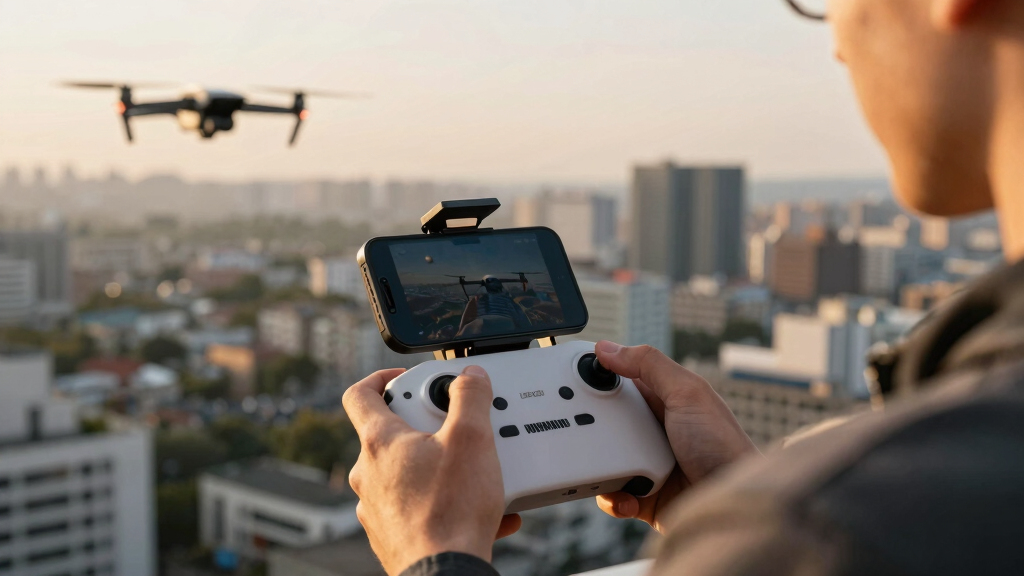

📊 Full opportunity report: The Eye Over The City: How Wide-Area Motion Imagery Works — And Where It Goes Blind on ThorstenMeyerAI.com — validation score, market gap, and execution plan.

Get business pricing on office and shipping supplies
- Business-only prices and quantity discounts
- Tax-exempt purchasing
- Multiple users, one account, clear invoices
TL;DR
Wide-Area Motion Imagery (WAMI) allows monitoring entire cities in real-time, providing a forensic record of movement. Its reliance on AI and physical limits shape its current and future use.
Wide-Area Motion Imagery (WAMI) is revolutionizing surveillance by enabling authorities to monitor entire cities simultaneously, recording and archiving every movement for later analysis. This technology, used by military and civilian agencies, offers a persistent, comprehensive view that surpasses traditional cameras, making it one of the most significant surveillance tools of the last two decades.
WAMI systems, such as DARPA’s ARGUS-IS, utilize an array of thousands of cameras to produce a single gigapixel image, covering several square kilometers from high altitude. These systems can track multiple moving objects in real-time, with the ability to rewind recordings to analyze incidents in detail. They are mounted on various platforms, including aircraft, drones, and tethered balloons, and are primarily used for military intelligence, border security, and disaster response.
However, WAMI’s optical sensors are limited by weather conditions, darkness, and the need for platforms to loiter overhead within physical reach of targets. To address these limitations, synthetic aperture radar (SAR) complements WAMI by providing all-weather, day-and-night coverage, especially over denied or contested airspace. The integration of optical and radar sensors, known as layered sensing or sensor fusion, enhances overall surveillance capabilities.
Despite its advantages, WAMI’s reliance on high data rates, AI for automation, and physical platform constraints means it cannot operate independently in all scenarios. Its development has evolved from early 2000s experiments to widespread deployment across military and civilian sectors, with ongoing innovations aimed at increasing its efficiency and scope.
The eye over the city: how Wide-Area Motion Imagery works — and where it goes blind
A normal drone sees through a soda straw. WAMI watches an entire city at once, tracks every mover, and records it all for forensic rewind. Immense reach — with hard limits that make radar and AI its necessary partners.
- City-scale motion, fine detail
- Forensic rewind
- Cloud / smoke / dark degrade it
- Needs a platform loitering overhead
sensing
+ AI
- Sees through cloud & total dark
- Tasked over denied airspace
- Persistent, wide-area from orbit
- Sovereign · on-prem · air-gap
The same archive that traces a bomber to a safe house can trace anyone home — retroactively, without prior suspicion. Baltimore’s secret 2016 deployment led to a 2021 federal ruling that persistent aerial tracking violated the Fourth Amendment. The security value is real; so is the mass-surveillance risk. Who owns the sensor, the archive, and the AI is the accountability question.
WAMI’s power is the archive and the AI reading it; its weakness is weather, airspace, and oversight. The mature posture isn’t optical-vs-radar or capability-vs-liberty — it’s layered sensing (optical WAMI + all-weather SAR), AI-enabled exploitation, and sovereign, auditable control of the whole chain. WAMI shows what a persistent eye can do with clear skies and owned airspace; for the cloud, the night, and the denied area, the radar layer is where the resilient coverage lives.
Implications of WAMI for Urban and Military Surveillance
WAMI’s ability to provide persistent, city-wide surveillance has profound implications for national security, law enforcement, and disaster management. Its detailed, archived imagery enables forensic analysis, potentially deterring criminal activity and enhancing situational awareness. However, it also raises privacy concerns and governance questions about surveillance limits and oversight, which are already being addressed in courts and policy debates.
wide-area motion imagery surveillance system
As an affiliate, we earn on qualifying purchases.
As an affiliate, we earn on qualifying purchases.
Evolution and Current Use of Wide-Area Motion Imagery
WAMI technology originated in the early 2000s with the Sonoma Persistent Surveillance Program and transitioned to military use with systems like Constant Hawk and Gorgon Stare deployed in Iraq and Afghanistan. Over time, miniaturization and platform diversification have expanded its deployment, including on drones like Reaper aircraft. Its applications now extend beyond military operations to civilian uses such as wildfire mapping and disaster response, reflecting its growing importance.
“WAMI systems are like city-sized cameras that record everything, and their forensic power is unmatched. But they depend heavily on AI for automation and face physical and weather-related limits.”
— Thorsten Meyer, AI and Surveillance Expert
high altitude city monitoring drone
As an affiliate, we earn on qualifying purchases.
As an affiliate, we earn on qualifying purchases.
Current Challenges and Limitations of WAMI Technology
While WAMI offers extensive coverage, its reliance on optical sensors makes it vulnerable to weather conditions, such as cloud cover, haze, and darkness. Its dependence on loitering platforms raises issues of cost, airspace access, and contested environments. The extent of future integration with other sensor types, like advanced radar, and the development of AI for autonomous analysis remain ongoing areas of research and debate.
gigapixel city surveillance camera
As an affiliate, we earn on qualifying purchases.
As an affiliate, we earn on qualifying purchases.
Future Developments and Integration of WAMI Systems
Advancements are expected in sensor miniaturization, AI automation, and multi-sensor fusion, which will enhance WAMI’s effectiveness and operational flexibility. Researchers and defense agencies are exploring satellite-based WAMI and improved radar integration to overcome current constraints. Policy and governance frameworks are also likely to evolve as the technology’s capabilities expand and its societal implications become more prominent.
synthetic aperture radar all-weather surveillance
As an affiliate, we earn on qualifying purchases.
As an affiliate, we earn on qualifying purchases.
Key Questions
How does WAMI differ from traditional surveillance cameras?
WAMI covers entire cities or large areas in a single frame, enabling tracking and forensic analysis of multiple moving objects simultaneously, unlike traditional cameras which focus on narrow fields of view.
What are the main limitations of WAMI?
Its optical sensors are affected by weather, darkness, and require platforms to loiter overhead. High data rates and reliance on AI automation also present operational challenges.
How does WAMI integrate with other sensing technologies?
WAMI is often combined with synthetic aperture radar (SAR) for all-weather, deep-denied coverage, creating layered sensing that compensates for each modality’s limitations.
What are the privacy concerns related to WAMI?
Continuous, city-wide surveillance raises questions about privacy rights and oversight, prompting legal and policy debates on its appropriate use.
What is the future of WAMI technology?
Future developments include miniaturization, enhanced AI automation, satellite-based systems, and integrated sensor networks, expanding WAMI’s capabilities and applications.
Source: ThorstenMeyerAI.com
Columbus Day / Indigenous Peoples' Day Picks
long weekend sales
As an affiliate, we earn on qualifying purchases.