🔍 Read the full analysis: What We’re Setting Up On Our UGREEN NASync DXP6800 Pro For AI on ThorstenMeyerAI.com

Get business pricing on office and shipping supplies
- Business-only prices and quantity discounts
- Tax-exempt purchasing
- Multiple users, one account, clear invoices
TL;DR
Thorsten Meyer says he bought a UGREEN NASync DXP6800 Pro after duplicate iCloud sync files nearly filled a database server and backup cleanup timed out. The NAS is equipped but not yet connected or configured; its planned RAID, snapshots and offsite backup remain untested.
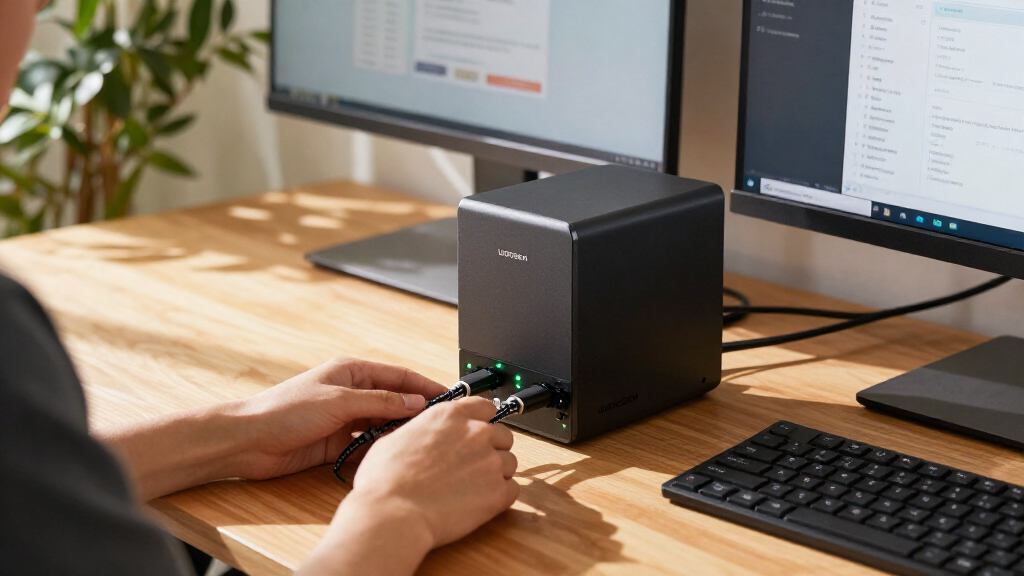
Thorsten Meyer says he has bought a UGREEN NASync DXP6800 Pro after duplicate files in an iCloud folder left a database server with just 2% free disk space. The NAS has arrived with four hard drives and an NVMe SSD, but it is not connected to the network, and the proposed backup system has not been tested.
Meyer, writing on ThorstenMeyerAI.com on November 1, 2026, says two machines uploaded database dumps with the same file name to one iCloud folder on September 17. The service retained repeated conflict copies; Meyer counted 29 duplicates as the database server approached full capacity. On October 29, a separate nightly job reported an error after cleanup of old dump files timed out while iCloud was busy.
The planned storage arrangement uses four Seagate IronWolf Pro 16 TB drives in RAID 6, which Meyer estimates would provide about 32 TB of usable capacity. A separate NVMe SSD is intended for containers and test databases. He says the NAS has six drive bays, leaving room to expand; filling all six with 16 TB drives in the same RAID configuration would provide about 64 TB before other storage overheads.
The proposed safeguards include separate, quota-limited accounts for each Mac, daily snapshots that those accounts cannot access or delete, and an encrypted offsite copy sent with restic to Backblaze B2 with Object Lock. Meyer says the system is still a plan: the machines currently use local Time Machine disks and an iCloud copy of the nightly database dump. He says he bought the hardware himself, received no UGREEN sponsorship or sample, and has no affiliate links in the article.
Infographic 01 · The box
Six bays, two fast slots, two 10GbE ports
What UGREEN lists for the NASync DXP6800 Pro, and how we plan to fill it.
How we fill it
Delivered and equipped; the setup is our plan (1 Nov 2026)
Bays 1–4: Seagate IronWolf Pro 16 TB, RAID 6, Btrfs → ≈ 32 TB usable, any two drives may fail. Bays 5–6: free for growth. M.2 slot 1: the NVMe SSD (ordered: Samsung 990 Pro 1 TB) as its own fast pool. Slot 2: free. Six 16 TB drives in RAID 6 would give ≈ 64 TB.
What else UGREEN lists
From the product page, not measured by us
- Separate 128 GB SSD for the operating system, UGOS
- RAID: JBOD, Basic, 0, 1, 5, 6, 10
- 1× PCIe x4 · 2× Thunderbolt 4 · 8K HDMI · SD card reader
- Power: 43.07 W drives in use · 24.91 W drives in hibernation
- Stated maximum: 208 TB with 32 TB drives · 3-year warranty
Why six bays: with RAID 6, two drives always hold parity. In four bays that leaves half the raw space usable; with all six bays filled it becomes two thirds.
Sources: UGREEN DXP6800 Pro product page, checked 1 Nov 2026; Seagate IronWolf Pro data sheet DS2129.4; our setup plan, 6 Oct 2026.
Powered by Thorsten Meyer AI
Replacing Sync With Layered Backups
The purchase addresses a failure in the backup route, not a shortage of storage. A sync service can faithfully reproduce changes, including unwanted files or deletions; Meyer says the duplicate dumps consumed disk space and made cleanup unreliable. A local NAS could provide a faster restore point on the office network, while a separate offsite copy would protect against a local failure.
That distinction matters for the small operation Meyer describes: several Macs run a publishing database, local AI models, content pipelines and tests. A disk filling or a server crashing can disrupt those services. But a NAS is not itself a complete backup strategy. The planned snapshots and offsite copy must work as intended, and the storage arrangement has not yet passed its acceptance tests.
Meyer also plans to move test databases off his laptop and run disk-heavy work overnight, from 20:00 to 06:00, so the drives can sleep during the workday. These are intended uses, not measured results; noise, restore speed and day-to-day reliability remain unreported.
Popular right now

Ninja CREAMi 7-in-1 Ice Cream Maker, NC299AMZ

Shark Rocket Ultra-Light Corded Stick Vacuum, HV301, Gray/Orange

Shark PowerPro Reveal Plus Cordless Vacuum Cleaner, Charcoal, IZ376H
As an affiliate, we earn on qualifying purchases.
Why the Six-Bay Model
Meyer reports that measurements taken October 6 showed about 2.6 TB in use on his main desk machine, 744 GB on the database server, and 3.2 TB on the model server, much of it in AI model files that can be downloaded again. He puts current backup needs at roughly 6 to 8 TB. The database itself was about 293 GB.
He says he chose the DXP6800 Pro over a cheaper four-bay option because he wanted the extra bays to allow growth without replacing existing drives. According to specifications from UGREEN, the model has a 10-core Intel Core i5-1235U processor, two 10GbE ports, two M.2 slots and 8 GB of DDR5 memory expandable to 64 GB. Those are manufacturer specifications, not independently tested performance results in Meyer’s account.
The purchase followed recurring kernel panics on the database Mac, which Meyer says had been occurring since August and, at their worst, about every five days. A crash on August 8 caused 2¼ hours of database downtime. He says local storage would not prevent another crash, but could shorten recovery compared with downloading a large restore over an internet connection. The article also cites the 3-2-1 backup principle: three copies, on two types of media, with one copy offsite.
“A sync service is not a backup.”
— Thorsten Meyer, ThorstenMeyerAI.com
Setup and Safeguards Remain Untested
As of November 1, the NAS had been delivered and equipped with four hard drives and one NVMe SSD, but had not joined the network. The planned RAID 6 pool, account quotas, daily snapshots, container storage and Backblaze B2 copy are therefore not confirmed as operating. Meyer says two acceptance tests must pass before he proceeds: Time Machine backups using a non-admin account and snapshots that the account cannot reach or delete.
It is also unclear how long configuration and testing will take, whether the chosen software will enforce the intended permissions, or how quickly a real restore will complete. Meyer has not reported power use, noise, performance or results from the proposed offsite protection. He says the NAS will not receive direct internet access, AI agents will not have administrator credentials, and UGREEN’s cloud mirror will not serve as the offsite backup; those are stated plans rather than tested controls.
Acceptance Tests Before Rollout
Meyer says he will first test Time Machine with a non-admin account and verify that snapshots remain inaccessible to that account. If either test fails, he says he will return the NAS. If the tests pass, the next steps are to configure the planned storage pools and backup layers, then report results from the system in use.
Until that follow-up, the existing backup arrangement remains in place: local Time Machine disks on two Macs and an iCloud copy of the nightly database dump. Actual restore times, snapshot behavior, offsite-copy protection and the NAS’s effect on the publishing and AI workloads have yet to be established.
Key Questions
Is the UGREEN NAS already backing up the computers?
No. Meyer says it has been delivered and equipped, but is not yet connected or set up. The existing local Time Machine and iCloud backups remain in use.
Why did Meyer buy the six-bay DXP6800 Pro?
He says the six bays provide room to add drives later without replacing the existing ones. He chose it over a less expensive four-bay model for that expansion capacity.
How much storage is planned initially?
The proposed RAID 6 pool uses four 16 TB drives, which Meyer estimates will provide about 32 TB usable. He estimates six such drives in RAID 6 could provide about 64 TB; actual usable capacity can vary with formatting and system overhead.
What caused the iCloud backup problem?
Meyer says two machines uploaded database dumps with the same file name to a shared folder. iCloud kept conflict copies, and he counted 29 duplicates before the database server reached 2% free disk space.
What must happen before the NAS is accepted?
Meyer says the setup must pass two checks: Time Machine backups must work with a non-admin account, and snapshots must remain beyond that account’s reach. He says the NAS will be returned if either test fails.
Source: ThorstenMeyerAI.com