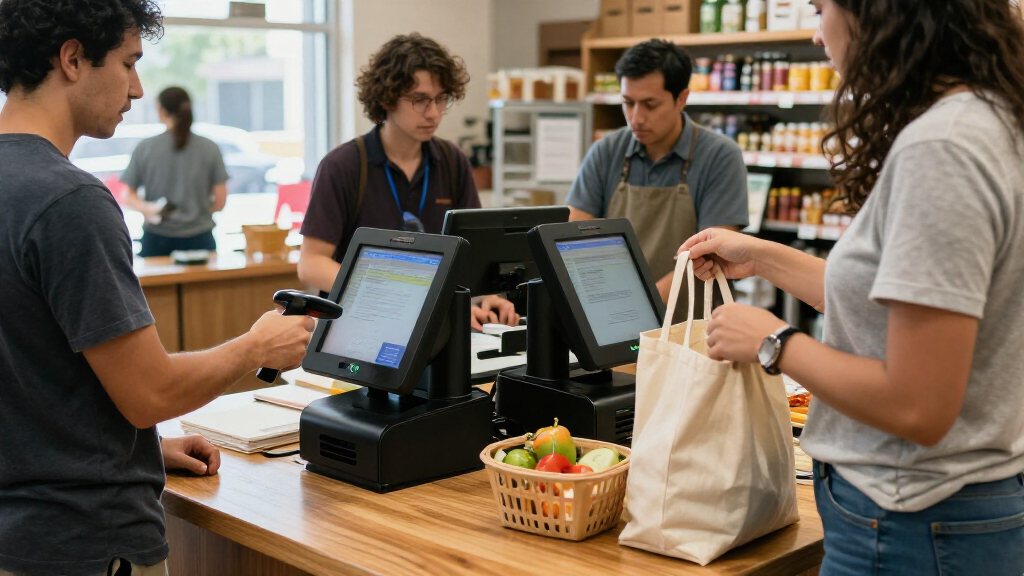
🔍 Read the full analysis: Customers And Kiosks: Who Handles Each Checkout Step? on ThorstenMeyerAI.com

Get business pricing on office and shipping supplies
- Business-only prices and quantity discounts
- Tax-exempt purchasing
- Multiple users, one account, clear invoices
TL;DR
A November 26, 2026, article from ThorstenMeyerAI.com traces how self-service retail shifted parts of checkout work from employees to customers, from Piggly Wiggly in 1916 to barcode scanning and self-checkout. U.S. cashier employment was about 3.1 million in 2025, and the Bureau of Labor Statistics projects a 6% decline by 2035; the article also notes that some retailers have scaled back self-checkout while others continue using it.
A November 26 report from ThorstenMeyerAI.com traces how grocery retailers have shifted parts of checkout work from employees to customers, from shoppers selecting their own goods in 1916 to scanning and bagging purchases at self-checkout. The account places that change alongside a continuing U.S. cashier workforce: the Bureau of Labor Statistics counted about 3.1 million cashier jobs in 2025 and projects a 6% decline from 2025 to 2035.
The report begins with Piggly Wiggly, which opened in Memphis in 1916. Rather than asking a clerk to fetch each item, customers walked the aisles and selected goods themselves. Clarence Saunders later patented a store layout that guided shoppers past merchandise to a checking and payment station. The report cites the Tennessee Encyclopedia’s description of the arrangement: clerks no longer fetched groceries, while shoppers selected items from shelves within reach.
The next major shift came through barcodes and automated scanning. GS1 identifies a ten-pack of Wrigley’s Juicy Fruit gum scanned at a Marsh supermarket in Troy, Ohio, on June 26, 1974, as the first product scanned with a barcode. In 1984, David R. Humble and colleagues filed a patent for a self-service distribution system. Its design had shoppers scan items while a scale checked their weight; the original process still directed shoppers to take a printed list to a cashier for payment.
For employment, the article cites two BLS measures. The agency’s Occupational Employment and Wage Statistics survey counted 3,089,410 cashiers in May 2025, compared with 3,596,630 in May 2019. Separately, the Occupational Outlook Handbook lists 3,106,300 cashier jobs in 2025 and projects the occupation to shrink by 6%, or about 200,600 jobs, by 2035. The report says the BLS attributes the expected decline to self-service checkout and rising online sales.
Infographic 01 · A short history of self-service
From the clerk to the customer, 1916 to today
Each step moved a piece of the work across the counter: first fetching the goods, then reading the price, then scanning and ordering.
How the customer took over the clerk's work
- Before 1916: a clerk fetched, weighed and wrapped every item at the counter.
- 1916, Piggly Wiggly (Memphis): shoppers take the goods off the shelves themselves and pass a checking station to pay. Clarence Saunders files his patent on 21 October 1916.
- 26 June 1974, Troy, Ohio: a ten-pack of Juicy Fruit gum is the first product scanned with a barcode. A machine now reads the price.
- 9 July 1984: David R. Humble and two colleagues file the CheckRobot patent: the shopper scans, a scale checks the weight, a tunnel stops unscanned items. Payment still goes to a cashier.
- From 1986: CheckRobot machines in several Kroger supermarkets, as reported by CNN (2022).
- 2018: McDonald’s has kiosks in nearly 17,000 restaurants; in France, Italy and Spain well over half of in-restaurant orders go through them (company filing).
Sources differ on the exact opening day of the first Piggly Wiggly (6 or 11 September 1916). The Kroger installation is reported second-hand; we did not retrieve the 1987 newspaper original.
Sources: C. Saunders, US Patent 1,242,872 (1916/17); Tennessee Encyclopedia; GS1 Belgium & Luxembourg; Humble et al., US Patent 4,676,343 (1984/87); CNN (2022); McDonald's Form 10-K 2018.
Powered by Thorsten Meyer AI
Checkout Work Moves to Shoppers
The development matters because self-checkout changes who performs routine retail tasks, not simply which machine is used. Customers may now select, scan, bag and sometimes troubleshoot their purchases, while employees oversee stations or handle exceptions. Retailers can cover several checkout points with fewer workers, according to the BLS discussion cited in the report.
The employment figures show that automation has not eliminated cashier work. More than 3 million U.S. cashier jobs remained in 2025, even after decades of self-service technology. The projected decline is a forecast, not a count of jobs already lost, and the 2019-to-2025 comparison spans a period also shaped by the pandemic and growth in online shopping. The figures do not isolate the effect of self-checkout from those other forces.
The shift also affects the customer experience. The report says retailers in England and the United States, including Dollar General and Target, pulled back some self-checkout operations between 2023 and 2024, citing concerns such as service, losses and speed. It describes Germany and Japan as continuing to expand or use these systems. Those examples suggest retailers are making different choices about how to divide work between staff, customers and machines.
Popular right now

Sony BRAVIA 6 77-Inch OLED 4K HDR Smart Google TV with Gemini (K-77A60)

De'Longhi Magnifica Evo Automatic Espresso Machine with Milk Frother, Silver

Apple AirPods Pro with Wireless Charging Case
As an affiliate, we earn on qualifying purchases.
From Store Aisles to Scanners
The article frames self-checkout as part of a longer history of customers taking on work once done by store staff. Piggly Wiggly’s self-service format moved item selection to shoppers, but employees still checked and billed the goods. Saunders’ 1916 patent described a route through the store ending at a station where purchases were checked, packed and paid for.
Barcode scanning later made it possible for machines to read product prices, and the 1984 patent proposed letting shoppers operate the scanner. The report says CheckRobot’s system was installed at several Kroger supermarkets, with self-checkout machines introduced in 1986, citing CNN’s 2022 account. Early designs still included human involvement: the patented process had a cashier collect payment after the customer scanned items. The modern arrangement developed over time rather than replacing every checkout task at once.
The source also invokes social critic Ivan Illich’s term “shadow work” for unpaid tasks assigned to customers and households. That is an interpretive frame, not an employment statistic. The measurable evidence presented is the BLS job count and its projection; the report’s historical account explains how the work at checkout has been redistributed.
What the Job Figures Cannot Show
The available figures do not establish how much of the decline in cashier employment is caused by self-checkout alone. The comparison between 2019 and 2025 covers years affected by the pandemic and online shopping growth, and the BLS projection names both self-service stands and increasing online sales. The report does not provide a breakdown of each factor’s contribution.
The figures also use two different BLS measures: a May employment estimate of 3,089,410 and an Occupational Outlook Handbook count of 3,106,300 for 2025. They are not identical counts, and the source does not explain the difference in methodology. Nor does the material provide a consistent, comparable measure of retailer adoption across countries or explain how many stores have recently removed or added machines.
BLS Forecast Runs Through 2035
The next reference point in the source is the BLS outlook period, which projects cashier employment through 2035. That projection can be compared with future employment estimates, but it should not be treated as a guarantee: staffing levels and checkout formats may change as online sales, retail practices and customer preferences shift.
For shoppers and workers, the practical question is how retailers balance self-service with staffed checkout. The source records both pullbacks and continued use, but it does not identify a single direction for the industry as a whole. Further reporting would need updated employment data and comparable figures on store deployments to show whether the current mix is changing.
Key Questions
How many cashier jobs were there in the United States in 2025?
The source cites two BLS figures: 3,089,410 cashiers in the May 2025 Occupational Employment and Wage Statistics survey, and 3,106,300 cashier jobs in the Occupational Outlook Handbook’s 2025 count. The article does not explain the difference between the measures.
How much does the BLS expect cashier employment to change?
The BLS projects a 6% decline from 2025 to 2035, equivalent to about 200,600 fewer jobs, according to the source. This is a forecast, not an observed loss.
When did shoppers first scan their own groceries?
The source dates a self-checkout patent filing by David R. Humble and colleagues to July 9, 1984. It says self-checkout machines were introduced at Kroger in 1986, citing CNN.
Did self-checkout replace all cashier work?
No. The BLS counted more than 3 million cashier jobs in 2025. The source describes self-checkout as transferring scanning and bagging tasks to customers, while staff may supervise stations or complete other checkout duties.
Are retailers still expanding self-checkout?
The source describes a mixed picture: some retailers pulled back certain self-checkout operations between 2023 and 2024, while it says Germany and Japan continue to use or expand the format. It does not provide a comparable current adoption measure across markets.
Source: ThorstenMeyerAI.com