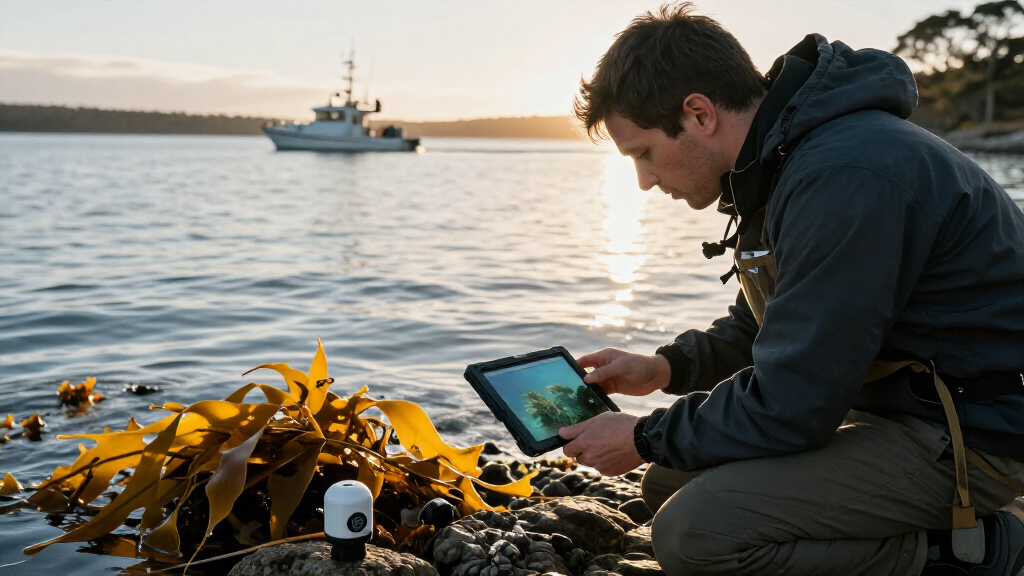

🔍 Read the full analysis: Can AI Help Protect And Restore Tasmania’s Giant Kelp? on ThorstenMeyerAI.com

Get business pricing on office and shipping supplies
- Business-only prices and quantity discounts
- Tax-exempt purchasing
- Multiple users, one account, clear invoices
TL;DR
Google said on November 12 that its AI and genomics work with CSIRO is being used to analyze wild Tasmanian giant kelp and inform selective breeding. Two Australian reference genomes are published in a peer-reviewed journal, but the reported analysis of 600 specimens has not yet been independently documented in a paper or dataset, and survival in warmer seas remains untested.
Google said November 12 that its AI tools are helping Australia’s national science agency, CSIRO, analyze the genetics of giant kelp in Tasmania, with the aim of selecting native plants for selective breeding. The work comes as kelp forests around Tasmania have declined by about 95%, according to CSIRO; whether bred kelp can survive warmer conditions in the ocean is still unknown.
The research uses AI to help interpret genetic data, not to plant kelp or measure heat tolerance on its own. Google says scientists used its open-source tools to build two reference genomes from Australian giant kelp, then trained a version of its DeepVariant software to analyze DNA from 600 wild specimens collected at 40 sites along the Tasmanian coast. Laboratory tests provide the trait measurements that researchers can compare with the genetic data.
The reference genomes are documented in a peer-reviewed BMC Genomics paper published in June 2026, co-authored by CSIRO scientists and a Google researcher. The paper reports that the two Australian genomes differ from each other by 0.2%, while each differs from the Californian reference genome by 1.5%. The researchers assembled 98% to 99% of each genome into 35 pseudo-chromosomes, according to the paper’s abstract.
The separate claim that analysis of the 600 specimens found the remaining Tasmanian kelp patches are genetically isolated comes from Google’s November announcement and video. The source material reports no paper or dataset for that analysis yet. The proposed next step is to cross genetically distinct native survivors in a lab, raise young kelp and plant them on reefs. The breeding is described as selective breeding, not genetic modification.
Giant kelp · Tasmania · CSIRO with Google AI
From the reef to the lab and back: where the AI fits
Five steps, as described by CSIRO and Google. The AI works in steps 2 and 3; people do the diving, the lab work and the planting.
1Reef
Collect wild kelp
600 wild specimens from 40 sites along the Tasmanian coast, according to Google.
2Lab + AI
Build a local reference
Long-read DNA plus Google’s DeepConsensus and DeepPolisher: two Australian reference genomes, published in BMC Genomics.
AI step3AI
Read each plant
A version of DeepVariant trained for kelp finds where each specimen’s DNA differs.
AI step4Lab
Choose and cross
Distinct survivors with genetic variation and heat-tolerant traits are crossed. Selective breeding, not genetic modification.
5Reef
Replant and watch
Young kelp is attached to rocky reef in pilot tests. Warm summers show which plants survive.
Sources: Google blog post, Nov 12, 2026, and Google Research video; Scharfenstein et al., BMC Genomics, 2026; CSIRO, 2024, and CSIRO on Google Arts & Culture. The scene is a schematic, not a map or real data.
Graphic: Powered by Thorsten Meyer AI
A Breeding Strategy for Kelp Survival
The project addresses a conservation problem with little room for the kelp to shift its range. CSIRO says the forests have declined by 95% and identifies warmer, nutrient-poor water and invading sea urchins among the pressures. The East Australian Current has extended farther south, bringing those conditions into Tasmanian waters, where warming in the Tasman Sea is reported to be twice the global average.
Giant kelp forests are habitat for a range of marine life, including fish, octopuses, sea stars and sea lions. CSIRO warns that losing the kelp forest means losing the ecosystem it supports. If researchers can identify surviving plants with useful traits and breed them, that could give restoration projects a locally sourced option. But the genetic work is a way to guide research, not proof that a restored forest will persist.
The practical test will come at sea, where young kelp must face the temperatures, nutrient conditions and other pressures that contributed to the decline. Until that testing happens, the research offers a possible route to restoration rather than evidence that it has succeeded.
Popular right now

KitchenAid 5.5-Quart Bowl-Lift Stand Mixer, Porcelain White

Philips Baristina Espresso Machine with Milk Frother (BAR308/60)

Bose QuietComfort True Wireless Earbuds with Active Noise Cancellation, Bluetooth 5.3, USB-C Charging, IPX4, Black
As an affiliate, we earn on qualifying purchases.
From Genome Mapping to Field Trials
Giant kelp, Macrocystis pyrifera, is a large brown seaweed that forms underwater forests in cold, shallow water. CSIRO says Tasmanian plants grow to around 30 metres, while individuals elsewhere can exceed 50 metres. The agency describes the forests as habitat for many marine species and says the kelp community is listed as an endangered marine community type.
The wider project was announced in February 2024 by Google Australia and partners including CSIRO, the University of Tasmania’s Institute for Marine and Antarctic Studies, The Nature Conservancy, the Great Southern Reef Foundation and the Kelp Forest Alliance. It included a mapping strand using satellite imagery and Google tools, as well as genomic research. The November 2026 announcement concerns the genomics strand.
Before the new work, the available giant kelp reference genome came from a Californian specimen. The Australian genomes address a concern that genetic differences between Northern and Southern Hemisphere kelp could make a distant reference less suitable for interpreting local samples. The published comparison found the Australian genomes were 1.5% different from the Californian genome, compared with 0.2% between the two Australian genomes.
“We trained a version of our AI model DeepVariant to analyze our wild samples.”
— Google, in a video accompanying its November 12 announcement
The Missing Test in Warmer Seas
The central uncertainty is whether selectively bred kelp will survive and grow through warmer summers after it is planted on reefs. That field test has not happened yet, and the available source material gives no results showing that the proposed breeding approach improves heat tolerance or long-term survival.
There is also a difference in the public evidence for the project’s two main results. The Australian reference genomes and their comparison with the Californian genome appear in a peer-reviewed paper. By contrast, the reported analysis of 600 specimens and genetic isolation among remaining patches is described in Google’s announcement and video; the source material says no paper or dataset for that analysis had been found. The detailed methods, results and any measured traits are therefore not yet independently assessable from the cited material.
The reported 95% decline is attributed to CSIRO; a cited preprint, drawing on earlier research, puts the loss of giant kelp cover in eastern Tasmania at 95% to 98% since 1940. Those figures use different descriptions and should not be treated as interchangeable measurements.
From Lab Crosses to Reef Planting
Researchers plan to cross distinct native survivors in the lab and raise young kelp for planting on reefs. The next evidence to watch for includes published details of the 600-specimen analysis, information on how scientists link DNA to laboratory-measured traits, and results from any reef plantings.
Those stages will show whether the approach moves beyond genomic analysis to successful restoration. Until field results are available, the key question remains whether the bred kelp can persist through warm summers in Tasmanian waters.
Key Questions
What is AI doing in the Tasmanian kelp project?
Google says AI tools helped assemble Australian giant kelp reference genomes and analyze genetic data from 600 wild specimens. The tools help researchers interpret DNA; they do not plant kelp or directly test heat tolerance.
Has the reported analysis of 600 kelp samples been published?
The source material identifies Google’s November 2026 blog post and video as the sources for that analysis and says no paper or dataset had been found. The two Australian reference genomes, a separate part of the work, are described in a peer-reviewed BMC Genomics paper.
Does the project genetically modify kelp?
No. The planned approach is described as selective breeding: crossing distinct native survivors in a laboratory and growing young kelp for reef planting, rather than genetically modifying the plants.
Has the bred kelp proved it can survive warmer water?
No such result is reported. The planned reef planting and survival through warm summers are still ahead, so the kelp’s performance in warmer sea conditions remains untested.
Source: ThorstenMeyerAI.com