
TL;DR

Get business pricing on office and shipping supplies
- Business-only prices and quantity discounts
- Tax-exempt purchasing
- Multiple users, one account, clear invoices
The old rule—build cheaper, buy faster—no longer holds. Today, you should compare actual costs, support, and control. Often, a hybrid approach or buying prebuilt offers better value for most users.
Building your own AI workstation used to be the obvious, cheap choice. But with chip shortages and skyrocketing prices in 2026, that’s no longer the case. Now, buying a prebuilt might save you time, stress, and even some money—if you pick the right vendor. But with chip shortages and skyrocketing prices in 2026, that’s no longer the case. Now, buying a prebuilt might save you time, stress, and even some money—if you pick the right vendor.
This article breaks down the real costs, the hidden tradeoffs, and when each approach makes the most sense. Whether you’re a hobbyist, a researcher, or running a business, understanding these nuances will help you make smarter decisions in this new landscape.
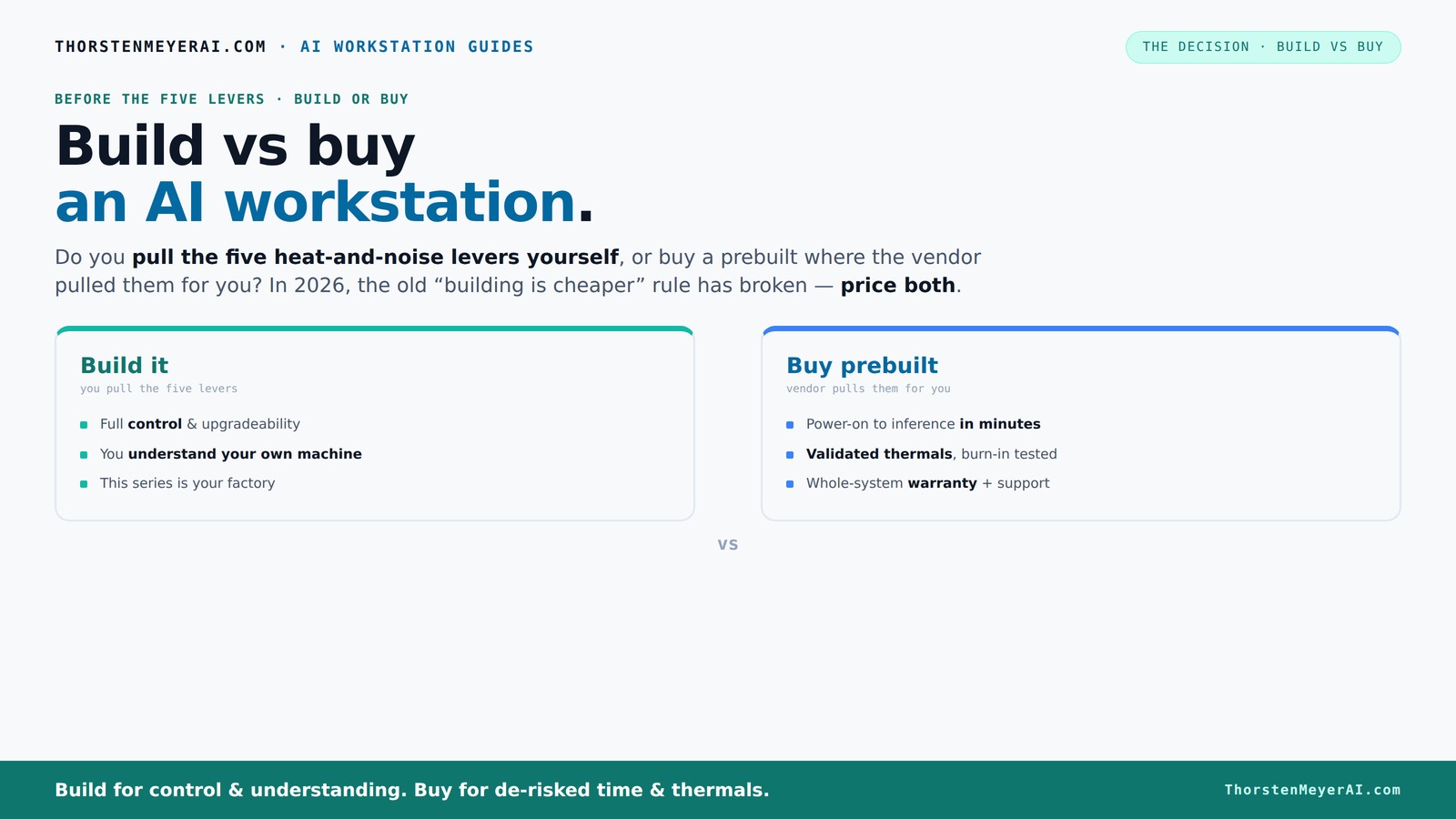
Build vs buy
an AI workstation.
The real question behind this whole series: do you pull the five heat-and-noise levers yourself, or buy a prebuilt where the vendor pulled them for you? And in 2026, the old “building is cheaper” rule has broken. Match your situation in Part 3.
Key Takeaways
- In 2026, component shortages make prebuilt AI workstations often as cost-effective as DIY builds—sometimes more so.
- Support, validated thermals, and warranty are major advantages of buying prebuilt—reducing downtime risks.
- Building your own system offers unmatched control over hardware, cooling, and upgrade paths, but demands technical skill.
- Hybrid solutions blend the speed of prebuilt platforms with custom tuning, ideal for workload-specific needs.
- Always compare total cost of ownership, including setup time, support, upgrades, and maintenance, before deciding.
As an affiliate, we earn on qualifying purchases.
Why 2026 Changes the Game: Building Isn’t Always Cheaper Anymore
Component shortages and bulk buying have pushed prices up for parts like GPUs and RAM. A build that used to cost under $1,000 now easily hits $1,250+ before you add an OS or peripherals. Meanwhile, vendors who bought in bulk before the spike can offer systems at prices hard to beat.
For example, a high-end GPU like the NVIDIA RTX 4090, which was $1,600 in 2024, now can cost over $2,000 due to shortages. A prebuilt system from a reputable vendor might come in at a comparable—or even lower—price, with the added perks of validation and warranty. A prebuilt system from a reputable vendor might come in at a comparable—or even lower—price, with the added perks of validation and warranty.
So, the old rule—build cheap, buy fast—no longer applies. Instead, you need to compare actual prices for your specific setup today. This shift means your decision depends more on support, control, and long-term costs, not just initial price.
Implication: This cost shift forces buyers to think beyond the sticker price. It highlights the importance of considering long-term support, upgradeability, and total cost of ownership, as initial savings may be offset by hidden expenses or limited flexibility later.
As an affiliate, we earn on qualifying purchases.
The Five Levers of Thermal and Noise Control—Who Pulls Them?
Running an AI workstation smoothly means managing heat and noise—think of it as a furnace that needs careful tuning. The five levers are undervolting the GPU, matching cooling solutions, fixing airflow, tuning fans, and positioning the machine.
If you buy prebuilt, the vendor handles all that—validated cooling, optimized fan curves, often water-cooling for quieter operation. For example, BIZON systems are engineered to run up to 30% cooler and quieter under load.
Build it yourself, and you’re the one pulling those levers. You choose a quiet GPU, like those optimized for inference, pick a cooling solution, and set up airflow. It’s rewarding, but it requires expertise. For instance, undervolting the GPU can cut noise by 50% and temperature by 15°C, but only if you know how to tune it safely.
Deep understanding of thermal and noise management is critical because poor cooling or airflow can lead to thermal throttling, which reduces performance, or overheating that damages components. You can learn more about thermal management for AI workstations to optimize your setup. Conversely, optimal tuning can extend hardware lifespan, improve stability, and create a quieter environment—crucial for research or professional settings.
This control over thermals and noise directly impacts the reliability and longevity of your system, and it’s a key advantage of custom builds if you have the skills to optimize these factors.
As an affiliate, we earn on qualifying purchases.
When Buying Is the Clear Winner
Opt for a prebuilt if you want plug-and-play convenience and support. For example, a research team that needs to deploy a system quickly for a project in just a few weeks benefits from vendors who test and validate their systems. They get a machine ready to run CUDA, TensorFlow, and Docker right out of the box.
Warranties and support matter too. If something fails during a long training job, having a vendor handle repairs or replacements reduces downtime. For high-end multi-GPU setups, vendors like Lambda verify cooling and power, reducing the risk of throttling or failures.
Choosing prebuilt minimizes the risk of compatibility issues, which can be costly and time-consuming to troubleshoot. This is especially critical for teams with tight deadlines or limited technical staff, where the priority is reliable operation rather than customization.
Additionally, prebuilt solutions often come with optimized thermal management and noise reduction, which can be challenging to achieve with a DIY build without significant expertise. For users who value stability, support, and rapid deployment, prebuilt is often the smarter choice.
As an affiliate, we earn on qualifying purchases.
When Building Yourself Makes Sense
If you’re a hobbyist, researcher, or company with in-house expertise, building your own system can give you unmatched control. You pick the exact GPU, cooling, and case—like choosing a quiet, airflow-optimized case from here. You tune every setting for your workload.
Building also lets you upgrade specific parts later—adding more RAM or swapping GPUs without replacing the whole system. For tips on choosing components, visit Build vs Buy a Prebuilt AI Workstation. For example, starting with a single GPU and adding a second later can be more cost-effective than buying a dual-GPU prebuilt upfront.
Deep involvement in the building process provides valuable insight into hardware interactions, thermal dynamics, and system stability, which can be crucial for troubleshooting and future upgrades. For more guidance, see our reviews of DIY vs prebuilt AI workstations. This knowledge can prevent costly mistakes and improve your ability to maintain the system over its lifespan.
Moreover, customization enables you to optimize for specific workloads—whether that’s maximizing inference speed, minimizing noise, or balancing power consumption. This flexibility can translate into better performance per dollar over the long term, especially if your needs evolve. Learn more about building vs buying to make the best choice for your setup.
Compare the Costs and Benefits: Build vs. Buy
| Aspect | Build |
|---|---|
| Cost | Lower upfront for hobbyists, but can be higher due to shortages and time spent; long-term costs include maintenance and upgrades |
| Time to deploy | Longer—weeks to months, depending on sourcing and assembly, with potential delays from compatibility issues |
| Support & Warranty | Variable, depends on your skills; risk of downtime without vendor support; no integrated warranty |
| Control & Customization | Highest—full control over components, thermals, and tuning for specific workloads |
| Scalability | Excellent—easy to upgrade individual parts, with potential for future expansion |
| Thermals & Noise | Variable—depends on your tuning skills, component choices, and thermal management expertise |
| Aspect | Prebuilt |
|---|---|
| Cost | Often comparable or lower due to bulk buying, especially in 2026; includes support and validation costs |
| Time to deploy | Fast—days to a couple of weeks, with minimal setup required |
| Support & Warranty | Built-in—validated components, vendor support, long warranties, and support contracts |
| Control & Customization | Limited—mostly vendor options, with some scope for configuration |
| Scalability | Good, but often limited by form factor and vendor upgrade paths; some modular options available |
| Thermals & Noise | Optimized—validated cooling and noise reduction, often superior to DIY without extensive tuning |
Understanding these tradeoffs helps you weigh immediate needs against long-term goals, balancing control, support, and total cost of ownership.
The Hidden Costs You Might Not Expect
Building your own system might seem cheaper at first glance, but hidden costs can erode those savings. Time spent sourcing parts, dealing with compatibility issues, and tuning thermals can add up quickly, especially if parts arrive late or are incompatible. These delays can delay project timelines, increase labor costs, and reduce productivity.
Buying prebuilt includes testing, validation, and support—costs embedded in the price. However, extended warranties or support contracts can add to the total expense, but they often save money by reducing downtime and repair costs in the long run.
For example, if your DIY build fails during a critical training session, troubleshooting and fixing the issue can take days or even weeks, causing delays and potential revenue loss. These hidden costs—time, stress, and potential hardware damage—are often underestimated but crucial to consider when evaluating overall value.
Future Upgrades and Scalability—What Works Better?
Want to grow your AI system over time? Building offers superior upgradeability because you control every component—swapping out GPUs, adding RAM, or improving cooling without replacing the entire system. For example, starting with a single GPU and adding another later can be more cost-effective and less disruptive than buying a new system.
Prebuilt systems, however, often have limited upgrade paths designed for specific configurations. While some vendors now offer modular designs that facilitate upgrades—like additional RAM slots or PCIe expansion—they usually come at a premium. These options can extend the lifespan of a prebuilt, but at higher initial costs.
Assess your long-term needs carefully. If your plan involves significant scaling, building your own system provides the flexibility to adapt as workloads grow, ensuring you’re not locked into a fixed configuration. This approach minimizes the need for complete replacements and can be more economical over multiple upgrade cycles.
Support, Warranty, and Reliability: Which Is Safer?
Prebuilt systems come with validated components and manufacturer warranties—this significantly reduces the risk of hardware failure. If something breaks, you benefit from vendor support, often including on-site repairs, rapid replacements, and dedicated customer service. For instance, Lambda offers comprehensive support plans that cover hardware issues for up to 3 years, ensuring minimal downtime for mission-critical projects.
Building your own system shifts more risk onto you. Troubleshooting hardware issues requires technical expertise, and finding compatible replacements can be time-consuming. Without vendor support, you may experience longer downtimes, lost productivity, and higher repair costs, especially if you lack experience in hardware diagnosis and repair.
For high-stakes AI workloads where uptime and reliability are paramount, the security of vendor-backed support and warranties can be a decisive factor. It reduces the stress and uncertainty associated with hardware failures, ensuring your projects stay on track.
Hybrid Strategies: Combining the Best of Both Worlds
Many organizations now adopt a hybrid approach: buy a validated platform and then customize the software or hardware layers to suit specific workloads. This reduces the risks associated with entirely DIY builds while still giving control over critical components or tuning.
For example, you might purchase a prebuilt from Lambda and then add custom cooling solutions or optimize BIOS settings for inference tasks. This approach allows rapid deployment combined with workload-specific tuning, which can be crucial when performance or thermal limits are tight.
Hybrid strategies are particularly effective when core hardware is commodity but your thermal or noise requirements are specialized. They offer a balanced route—leveraging proven reliability while customizing for maximum performance and efficiency.
Making the Final Call: Your Checklist to Decide
Here’s a quick checklist:
- Do you need fast deployment? → Buy.
- Are you comfortable tuning hardware and troubleshooting? → Build.
- Is support and warranty critical? → Buy.
- Want maximum flexibility? → Build.
- Need to get to productivity quickly? → Buy.
- Looking to learn and customize? → Build.
Remember, the best choice depends on your specific workload, technical expertise, and long-term goals. Weighing these factors carefully ensures your investment aligns with your strategic needs and resource availability.
Frequently Asked Questions
Is it cheaper to build or buy an AI workstation in 2026?
It depends on your specific needs and current market prices. Due to shortages and bulk buying, prebuilt systems are often as affordable or even cheaper than DIY, especially when you factor in time and support.How much performance do I lose with a prebuilt system?
Usually not much—modern prebuilt workstations are tested for thermals and stability. Vendors often tune for optimal performance, sometimes even better than a DIY with minimal thermal management skills.What hidden costs come with building my own system?
Expect to spend extra time sourcing parts, troubleshooting compatibility issues, and tuning thermals. Also, there's the risk of delays and additional labor costs if something goes wrong during assembly or setup.Can I upgrade a prebuilt workstation later?
Often yes, but it depends on the design. Some prebuilt systems are modular, allowing upgrades like adding RAM or swapping GPUs. Others are more restricted, so check the vendor’s upgrade policies before buying.Which option is better for long-term AI projects?
If you need maximum control and scalability, building your own system is ideal. For shorter-term or high-pressure projects, a prebuilt with support can get you started faster and with less risk.Conclusion
Today, choosing between build and buy for your AI workstation isn't a simple cost comparison. It's about aligning your technical skills, timeline, and long-term goals. Sometimes, paying a little more upfront for a validated, supported system saves headaches—and money—in the long run.
Think of your workstation as a foundation—solid, reliable, and tailored to your needs makes all the difference. When in doubt, remember: in 2026, the smartest move often involves blending the best of both worlds.
Halloween Picks
halloween
As an affiliate, we earn on qualifying purchases.