
📊 Full opportunity report: Small-Town Commercial Real Estate Meets Local Economic Development on IdeaNavigator AI — validation score, market gap, and execution plan.

Get office and shipping supplies delivered free — and shop member deals
- Fast, free delivery on millions of items
- Access to Prime Big Deal Days deals on October 6–7
- Prime Video, Amazon Music and more included
TL;DR
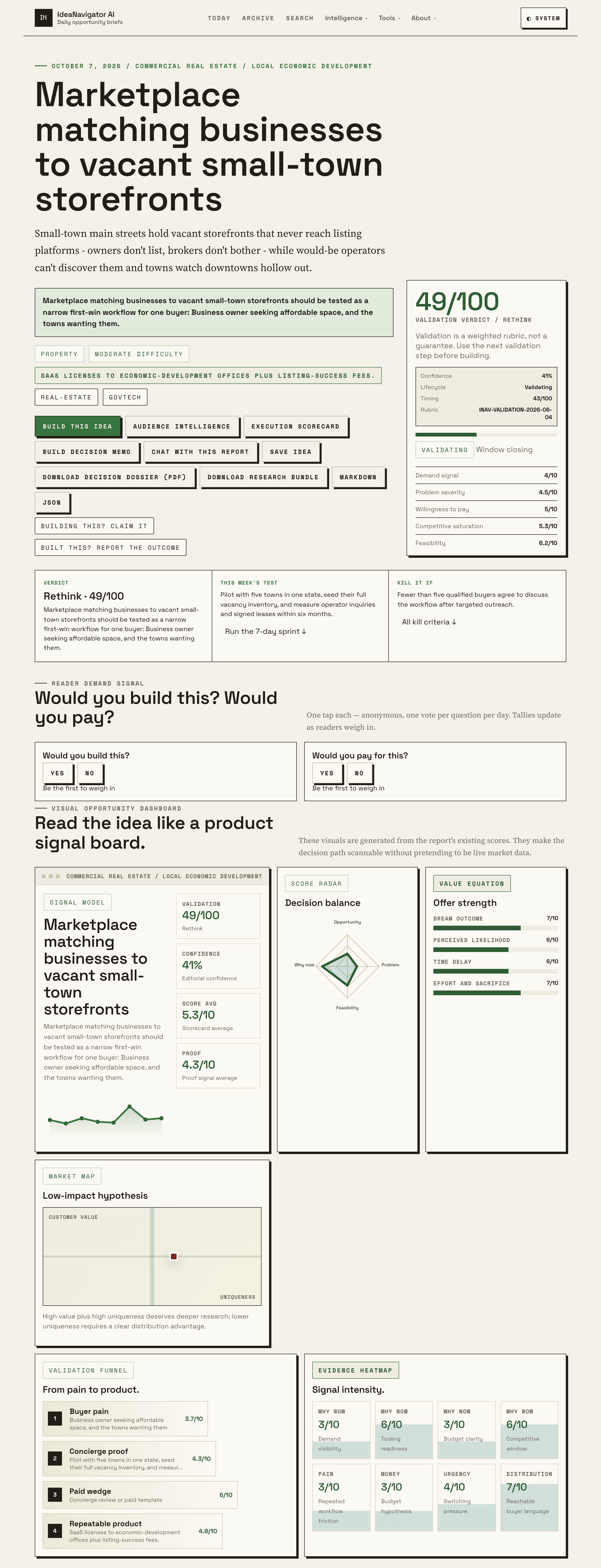
A proposed marketplace would connect small-town storefront owners and business operators, routing potential matches through local economic-development offices. The suggested test is a five-town pilot in one state that tracks operator inquiries and signed leases over six months; no pilot launch or results are confirmed.
IdeaNavigator AI has proposed testing a marketplace that would connect small-town storefront owners with business operators seeking affordable commercial space, with local economic-development offices helping route matches and identify available grants. The proposal recommends a five-town pilot in one state, but does not say that a marketplace has been built, towns have agreed to participate, or funding has been secured.
According to IdeaNavigator AI’s proposal, the service would address a discovery gap: some vacant storefronts are not listed on commercial property platforms, while potential operators may not know those spaces exist. The proposal says owners may not list their properties and brokers may not pursue them, leaving town officials concerned about vacant downtown premises. It provides no figures for how many properties are affected or how often operators fail to find space.
Under the proposed minimum viable product, towns and property owners would submit photos, size, rent and available incentive programs. Business operators could browse properties using town profiles and foot-traffic information. When an operator and property appear to match, the inquiry would go to the local development office, with relevant grants attached where available.
IdeaNavigator AI’s suggested validation plan is to collect a town’s full storefront-vacancy inventory in five towns in one state, then measure operator inquiries and signed leases over six months. The proposal identifies SaaS licenses for economic-development offices and fees tied to successful listings as possible revenue sources. It provides no projected costs, pricing, participating towns, or evidence that this business model has been tested.
A Vacancy List Tied to Local Incentives
As described in IdeaNavigator AI’s proposal, the marketplace would give business owners a single way to discover storefronts that may otherwise be hard to find, while offering towns a channel to introduce available grants and other incentives at the point of inquiry. The proposed handoff to local development offices makes the idea more than a property directory: it places municipal staff between a prospective tenant and information about local support.
The proposal’s stated goal is to improve the path from vacancy to a possible lease. That outcome is not established by the proposal, however. Inquiries would show whether operators are finding the listings; signed leases would offer a more direct, though still limited, measure of whether the matching process helps fill space within the pilot period.
The plan also raises practical questions for towns weighing participation. Staff would need to gather and maintain accurate listing details, respond to routed inquiries and confirm which incentives remain available. IdeaNavigator AI does not estimate those workload demands or show whether towns would pay for the service. Its value to readers is therefore as a testable local-development concept, not a demonstrated solution to commercial vacancy.
As an affiliate, we earn on qualifying purchases.
How the Proposed Pilot Would Work
IdeaNavigator AI frames the opportunity around two groups: operators seeking affordable space and towns seeking businesses for vacant storefronts. The proposal points to increased interest in small towns associated with remote-work migration, alongside economic-development offices that may have grant funding for matching efforts. It supplies no migration data, grant totals or named funding programs to substantiate those points.
The proposed test is limited rather than a broad launch: select five towns in one state, assemble each town’s full inventory of vacancies, and monitor activity for six months. This would let organizers observe whether listings generate inquiries and whether any inquiries become leases. The proposal does not specify how the towns would be chosen, how foot traffic would be measured, or how results would be compared with activity before the marketplace.
wireless receipt printer for retail
As an affiliate, we earn on qualifying purchases.
As an affiliate, we earn on qualifying purchases.
Pilot Participation and Results
No operating marketplace or pilot is confirmed in IdeaNavigator AI’s proposal. It names no participating towns, property owners, economic-development offices, grant providers or platform operator. It also gives no launch schedule, funding commitment, pricing, or details on who would verify listing information and keep it current.
The suggested measures—operator inquiries and signed leases within six months—are plans for evaluation, not reported outcomes. It remains unclear whether the proposed towns have enough unlisted vacancies to make a marketplace useful, whether operators would use it, and whether a lease could be attributed to the service. The proposal supplies no data to establish the scale of storefront vacancy or the claimed changes in small-town commercial interest.
As an affiliate, we earn on qualifying purchases.
Evidence Needed Before Expansion
IdeaNavigator AI’s proposal identifies a pilot across five towns in one state as the next step, beginning with a complete inventory of available storefronts. If organizers proceed, the stated evaluation period would run for six months and track both operator inquiries and signed leases. No timeline for starting that work has been announced.
Before any wider rollout, towns and the marketplace operator would need to clarify who maintains listings, how incentive eligibility is checked, what fees apply, and how results will be assessed. Until participants, funding and results are disclosed, the marketplace remains a proposal rather than a confirmed local economic-development program.
Source: IdeaNavigator AI proposal
commercial real estate listing software
As an affiliate, we earn on qualifying purchases.
As an affiliate, we earn on qualifying purchases.
Key Questions
Has the small-town storefront marketplace launched?
No launch is confirmed. IdeaNavigator AI’s proposal describes a proposed marketplace and pilot, without naming an operator or launch date.
What would the marketplace list?
The proposal says listings would include photos, storefront size, rent and incentive programs. Operators could also browse using town profiles and foot-traffic information.
How would the proposed pilot be evaluated?
IdeaNavigator AI’s plan calls for testing the service in five towns in one state, with operator inquiries and signed leases tracked over six months. No results have been reported.
How might the service make money?
The proposal identifies SaaS licenses for economic-development offices and fees tied to successful listings as possible revenue. It does not give prices or confirm that towns or property owners would pay.
What is still unknown about the idea?
Participating towns, funding, timing, operating responsibilities, listing accuracy procedures and pilot results have not been provided. The scale of the vacancy problem is also not quantified.
Source: IdeaNavigator AI
Halloween Picks
halloween
As an affiliate, we earn on qualifying purchases.