
📊 Full opportunity report: Employee handbook change digest for small employers on IdeaNavigator AI — validation score, market gap, and execution plan.

Get business pricing on office and shipping supplies
- Business-only prices and quantity discounts
- Tax-exempt purchasing
- Multiple users, one account, clear invoices
TL;DR
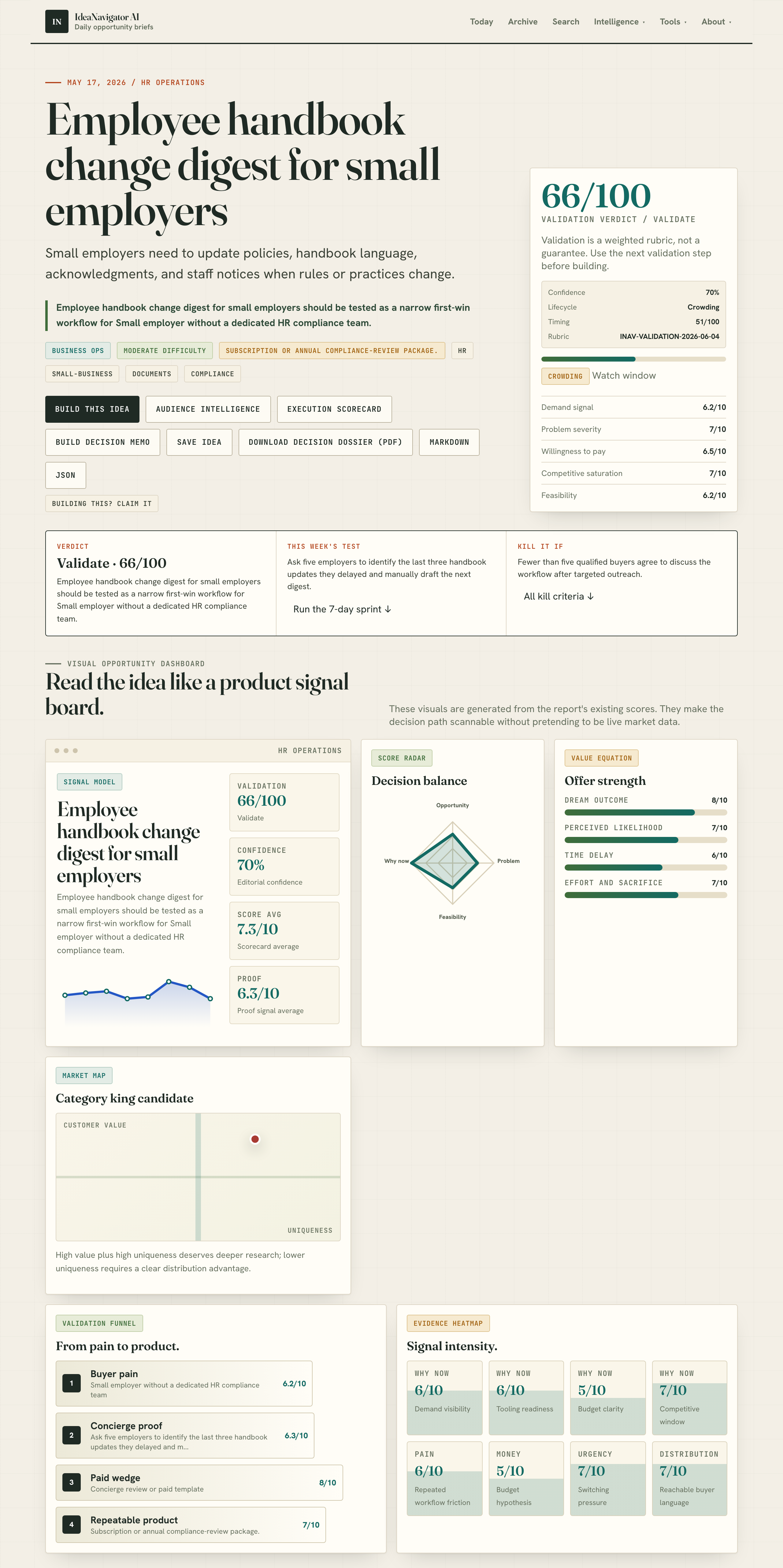
A new workflow for employee handbook updates is being tested for small employers without dedicated HR teams. It aims to streamline policy changes and tracking through digest logs. The initiative responds to increased policy drift amid remote work and evolving regulations.
IdeaNavigator AI is piloting a new workflow designed to help small employers without dedicated HR compliance teams manage employee handbook updates more efficiently. This initiative aims to address the growing challenges small businesses face in keeping policies current amid remote work, AI tools, and evolving state regulations.
The proposed workflow involves logging policy topics, drafting change notes, and tracking employee acknowledgment statuses, providing a structured approach to policy management. The pilot targets small employers that typically lack dedicated HR resources, aiming to reduce the administrative burden and ensure compliance.
According to IdeaNavigator AI, the MVP will be validated by asking five small employers to identify recent handbook updates they delayed and to manually draft the next digest, testing the workflow’s practicality and effectiveness. The service plans to generate revenue through subscription models or annual compliance review packages, targeting the HR operations market.
Implications for Small Employers’ Policy Management
This development could significantly ease the compliance burden for small employers, helping them stay current with policy changes without dedicated HR teams. Improved tracking and acknowledgment processes may reduce legal risks and ensure employees are informed of policy updates. If successful, it could set a new standard for small business HR operations, especially in a landscape of increasing regulatory complexity.Popular right now

Ninja NC501 CREAMi XL Deluxe 11-in-1 Ice Cream and Frozen Treat Maker with Two XL Containers

Bose QuietComfort Wireless Noise Cancelling Headphones, Sandstone

Vitamix 5200 Professional-Grade Blender, 64 oz. Container, Black
As an affiliate, we earn on qualifying purchases.
Growing Need for Simplified Policy Updates in Small Businesses
Small employers often struggle with maintaining up-to-date employee handbooks due to limited resources and the rapid pace of regulatory changes. Remote work and AI tools have increased the frequency of policy drift, making manual updates more challenging. Currently, many small businesses delay or overlook handbook revisions, risking non-compliance. The proposed workflow aims to address these issues by providing a streamlined, manageable process tailored for small teams without dedicated HR support.“The workflow aims to reduce the administrative burden on small employers by providing a structured way to log, draft, and track policy updates.”
— an anonymous researcher
Uncertainties Surrounding Workflow Effectiveness
It is not yet clear how effective the workflow will be in real-world settings or how small employers will adopt and utilize it. The pilot phase will provide initial insights, but broader validation and user feedback are still pending. Additionally, the long-term impact on compliance and legal risk reduction remains to be seen.
Next Steps for Pilot Testing and Market Rollout
IdeaNavigator AI plans to conduct pilot testing with five small employers, collecting feedback on usability and effectiveness. Based on the results, further refinements will be made before a wider launch. The company also intends to explore subscription and compliance review packages as revenue streams. A broader market rollout could follow if the pilot proves successful.
Key Questions
How does the new workflow help small employers manage policy updates?
It provides a structured process to log policy topics, draft change notes, and track employee acknowledgments, simplifying the update and compliance process.
Will this tool replace existing HR functions for small businesses?
No, it is designed as a support tool to assist small employers without dedicated HR teams, not to replace existing HR personnel or systems.
When will the workflow be available for wider use?
The initial pilot is ongoing, with plans for broader rollout contingent on pilot success. A public version may be available within the next year.
What costs are associated with using this workflow?
IdeaNavigator AI plans to offer it via subscription or annual compliance review packages, with pricing details to be announced after pilot completion.
What are the risks if small employers delay handbook updates?
Delays can lead to non-compliance with evolving regulations, potential legal liabilities, and employees being unaware of current policies, increasing organizational risk.
Source: IdeaNavigator AI