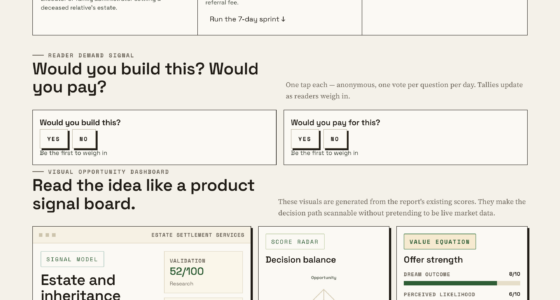
📊 Full opportunity report: An Empty Trust Tracker For Client Estate Plans on IdeaNavigator AI — validation score, market gap, and execution plan.

Get business pricing on office and shipping supplies
- Business-only prices and quantity discounts
- Tax-exempt purchasing
- Multiple users, one account, clear invoices
TL;DR
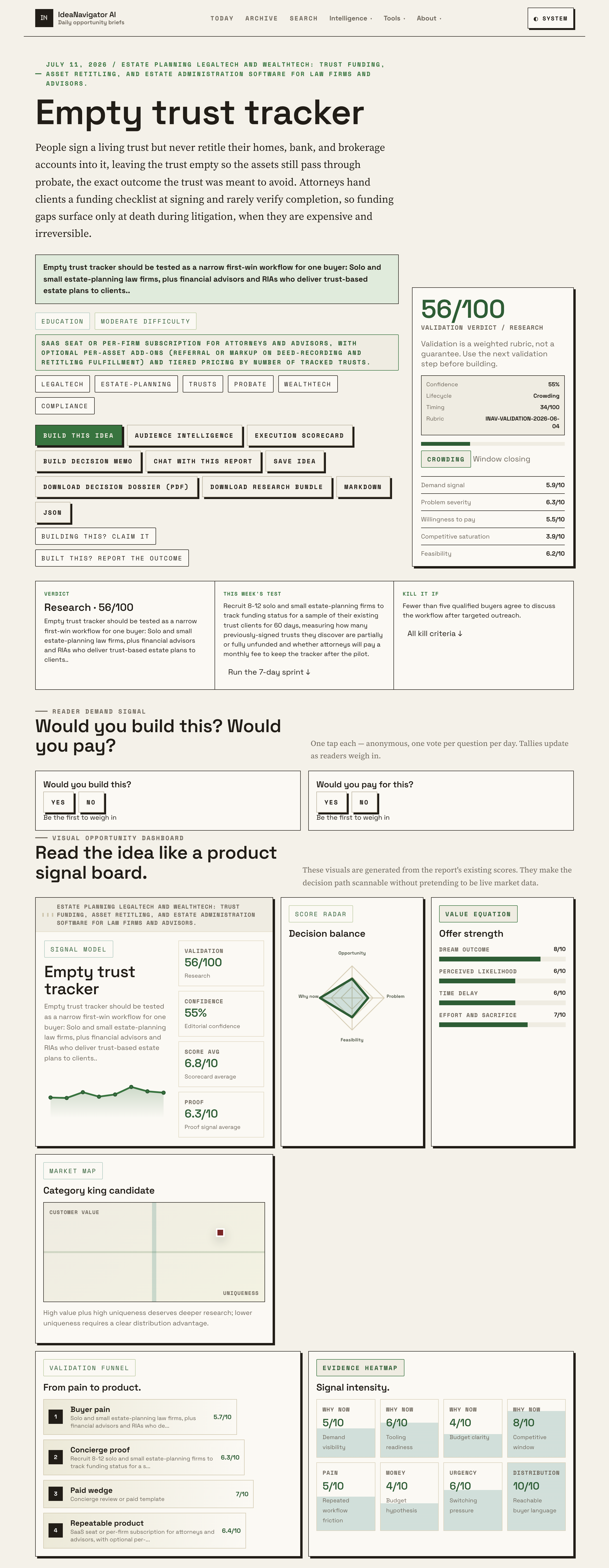
IdeaNavigator AI proposes a niche SaaS tool that lets estate-planning attorneys and advisors track whether client trusts are actually funded, asset by asset. The problem: signed living trusts often stay empty because homes and accounts are never retitled, pushing assets back into probate. The idea is unvalidated and awaits a 60-day pilot with 8-12 firms.
A new product proposal from IdeaNavigator AI targets a quiet but costly failure point in estate planning: living trusts that clients sign but never fund. The proposal, outlined as a narrow “first-win” workflow for solo and small estate-planning law firms and financial advisors, calls for a client-by-client tracker that verifies whether homes, bank accounts, and brokerage assets have actually been retitled into a trust before the client dies.
The core problem the proposal addresses is well known among practitioners: people sign a living trust but never retitle their homes, bank, and brokerage accounts into it, leaving the trust empty so the assets still pass through probate — the exact outcome the trust was meant to avoid. According to the proposal, attorneys typically hand clients a funding checklist at signing and rarely verify completion, so funding gaps surface only at death during litigation, when they are expensive and irreversible.
The proposed MVP is a per-client funding tracker. Attorneys or advisors would create a funding checklist for each trust covering real estate, bank, brokerage, retirement, business interests, and beneficiary designations; assign each asset a status of pending, in-progress, or confirmed funded; and attach proof such as a recorded deed or a retitled statement. Automated reminders would go to clients, and a dashboard would show each firm’s book of trusts by percent funded so partners can flag dangerously empty trusts before death.
The revenue model is a SaaS seat or per-firm subscription for attorneys and advisors, with optional per-asset add-ons — referral fees or markups on deed-recording and retitling fulfillment — and tiered pricing by the number of tracked trusts. The proposal situates the product in the estate planning legaltech and wealthtech market, covering trust funding, asset retitling, and estate administration software.
Why Unfunded Trusts Burn Clients
The proposal matters because it attacks a gap between document creation and real asset transfer. A trust only avoids probate for assets it actually holds; an unfunded trust provides the paperwork of protection without the substance. By the proposal’s account, that gap is typically discovered during post-death litigation, when remediation options are limited and costs fall on heirs. A verification layer that catches unfunded assets while the client is alive could change the economics of small-firm estate planning practice.
It also reflects a market shift. According to the proposal, estate planning adoption and digital tooling are surging in 2026, advisors and RIAs are racing to bundle funded estate plans into client offerings, and per-deed funding services priced from $250 have already created a paid market that a tracking layer can sit on top of. Existing document-drafting software, the proposal argues, does not close the funding step.
Top picks for "empty trust tracker"
As an affiliate, we earn on qualifying purchases.
Low Trust Adoption Meets Manual Funding
The proposal cites an estimate that only about 11% of Americans hold a trust, even as estate planning tooling expands. Trust funding remains a manual, fragmented step: it involves contacting banks, recording deeds with county offices, and updating beneficiary designations across institutions — tasks the client, not the attorney, usually performs after signing. That division of labor is why the proposal frames verification, rather than drafting, as the under-served niche.
The suggested validation path is deliberately modest: recruit 8-12 solo and small estate-planning firms to track funding status for a sample of their existing trust clients for 60 days, measuring how many previously signed trusts turn out to be partially or fully unfunded, and whether attorneys will pay a monthly fee to keep the tracker after the pilot.
Unproven Demand and Uncited Figures
The proposal is an idea, not a product: no pilot has been run, no firms are named as participants, and no validation results exist yet. The claimed pain point — widespread unfunded trusts discovered at death — is presented without cited survey data or litigation statistics, and the figure that roughly 11% of Americans hold a trust is attributed without a named source. The size of the 2026 surge in estate planning adoption is likewise uncited.
Whether attorneys or advisors would actually pay a recurring subscription for tracking, and whether clients will respond to automated funding reminders after the engagement has formally ended, are open questions the 60-day pilot is designed to answer. Pricing sensitivity, integration with existing practice management software, and how fulfillment markups would comply with professional responsibility rules for attorneys are also unaddressed in the proposal.
From Proposal to 60-Day Pilot
The stated next step is validation: recruiting 8-12 firms to track funding status for existing trust clients over 60 days. Two metrics would decide whether the idea advances — the count of previously signed trusts found to be partially or fully unfunded, and willingness to pay a monthly fee after the pilot ends. If both check out, the proposal envisions building the MVP tracker with per-trust checklists, proof attachments, automated reminders, and a percent-funded dashboard, followed by tiered subscription pricing and optional deed-recording fulfillment partnerships. No timeline for any of these stages has been set.
Source: IdeaNavigator AI
Key Questions
What is an “empty” or unfunded trust?
A living trust that has been signed but never holds any assets. If a home or accounts are never retitled into the trust, those assets generally still pass through probate — the court process the trust was created to avoid.
Who is the proposed tracker for?
Solo and small estate-planning law firms, plus financial advisors and RIAs who deliver trust-based estate plans to clients.
Has the product been built or tested?
No. It is currently a proposal from IdeaNavigator AI. The suggested validation step is a 60-day pilot with 8-12 firms to measure how many existing trusts are unfunded and whether firms would pay to keep the tool.
How would the tracker make money?
Through a SaaS seat or per-firm subscription, with optional per-asset add-ons such as referral fees or markups on deed recording and retitling services, and tiered pricing based on the number of trusts tracked.
Why don’t existing estate planning software tools solve this?
According to the proposal, current document-drafting software stops at generating the trust documents, while funding — retitling assets across banks, counties, and brokerages — remains a manual, fragmented step with no verification layer.
Source: IdeaNavigator AI
Fall Picks
fall essentials
As an affiliate, we earn on qualifying purchases.