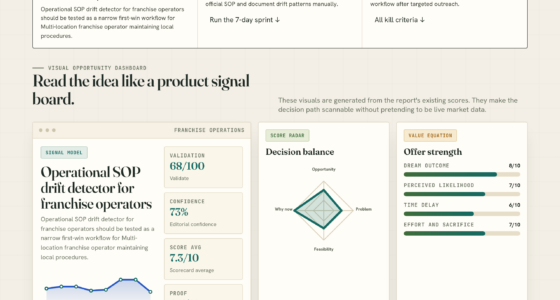

📊 Full opportunity report: The Nordics: Protect the Worker, Not the Job on ThorstenMeyerAI.com — validation score, market gap, and execution plan.

Get office and shipping supplies delivered free — and shop member deals
- Fast, free delivery on millions of items
- Access to Prime Big Deal Days deals on October 6–7
- Prime Video, Amazon Music and more included
TL;DR
Nordic countries adopt a ‘protect the worker, not the job’ approach, emphasizing income security and active labor policies over job protection. This model aims to reduce resistance to automation and facilitate economic transitions.
Nordic countries are implementing a labor approach that emphasizes protecting workers rather than jobs, a strategy that may ease societal adaptation to automation and economic shifts. This approach, rooted in the concept of ‘flexicurity,’ is gaining attention as a model for managing technological disruption.
The Nordic model, particularly Denmark’s ‘flexicurity,’ combines flexible employment laws with generous unemployment benefits and active labor market policies. This system allows employers to reconfigure their workforce quickly while providing workers with income security and retraining support. Unlike Germany’s Kurzarbeit, which aims to preserve existing jobs during downturns, the Nordic approach prioritizes supporting the individual worker through transitions, making societal resistance to automation less likely. Countries like Denmark, Finland, and Norway invest heavily in active labor policies, with unions playing a central role in setting wages and negotiating labor terms. Norway’s sovereign wealth fund exemplifies how the region manages ownership of capital, providing a form of collective ownership that supports economic stability. This model’s core premise is that safeguarding workers’ well-being reduces resistance to technological change and fosters a society better equipped to handle economic transformation.Protect the Worker, Not the Job
Where Germany saves the job, the Nordics let the job go and catch the worker. The counterintuitive result: unions that welcome automation — because the person is protected even when the role isn’t.
Independent commentary, produced with AI assistance under human editorial oversight. The views are the author’s own and may change. This is analysis, not policy, economic, investment, or legal advice. Descriptions of flexicurity, Nordic active-labor spending, Finland’s basic-income experiment, and Norway’s sovereign wealth fund reflect publicly reported information as of mid-2026 and may change. This phase maps differing approaches and endorses none; contested questions are presented with competing views, not a verdict. Country and program names are referenced for analysis and imply no affiliation.
Why Protecting Workers Over Jobs Changes Economic Transitions
This approach reduces societal resistance to automation by making change more survivable for individuals, potentially accelerating technological adoption and economic growth. It offers a pathway for other regions to manage disruption without widespread unemployment or social unrest, highlighting the importance of social safety nets and active labor policies in future economic strategies.flexicurity labor market policy books
As an affiliate, we earn on qualifying purchases.
As an affiliate, we earn on qualifying purchases.
Nordic Labor Policy Foundations and Global Implications
The Nordic model emerged in the 1990s with Denmark’s ‘flexicurity,’ emphasizing flexible labor markets combined with social security. Unlike traditional job protection strategies in Germany or France, the Nordic approach treats jobs as temporary and focuses on supporting workers through active retraining and income support. This strategy has contributed to high union density and collective bargaining, shaping a distinct social contract. The model’s success is linked to substantial public investment in active labor policies, which are significantly more robust than in other high-income countries. Norway’s sovereign wealth fund further exemplifies the region’s approach to managing capital ownership, providing a buffer against economic shocks. As automation and AI threaten traditional jobs worldwide, the Nordic experience offers an alternative framework focused on individual resilience rather than job preservation alone.“The Nordic approach treats jobs as temporary arrangements; people are treated as permanent, which fundamentally shifts how societies handle economic change.”
— Thorsten Meyer
unemployment benefit support tools
As an affiliate, we earn on qualifying purchases.
As an affiliate, we earn on qualifying purchases.
Unclear Aspects of the Nordic Model’s Scalability
While the Nordic model demonstrates success in its region, it remains uncertain how well these policies can be adapted to larger, more diverse economies with different social and political structures. The long-term fiscal sustainability of generous unemployment benefits and active labor policies also warrants further study, especially amid changing demographics and economic conditions.
As an affiliate, we earn on qualifying purchases.
Future Developments in Nordic Labor Policies and Global Adoption
Policymakers worldwide are observing the Nordic model as a potential blueprint for managing automation and economic transition. Future steps include evaluating the long-term fiscal impacts, expanding active labor programs, and exploring how these policies can be integrated into different political contexts. Ongoing research and policy experimentation will clarify the model’s broader applicability and sustainability.
active labor policy training courses
As an affiliate, we earn on qualifying purchases.
As an affiliate, we earn on qualifying purchases.
Key Questions
How does the Nordic model differ from traditional job protection strategies?
The Nordic model emphasizes flexible employment laws combined with strong income security and active labor policies, rather than rigid job protection laws that make firing difficult. It focuses on supporting workers through transitions rather than preserving specific jobs.
Can the Nordic approach be applied in larger or less homogeneous economies?
It is uncertain how easily the model can be scaled or adapted outside the Nordic context. Differences in political culture, social safety nets, and economic structure may pose challenges to direct implementation.
What role do unions play in the Nordic labor system?
High union density and collective bargaining are central, helping set wages and negotiate terms that support the flexible yet secure labor market model.
Does the model address the ownership of capital as well?
Yes, Norway’s sovereign wealth fund exemplifies collective ownership of capital, providing economic stability and supporting the model’s social goals.
What are the main criticisms of the Nordic approach?
Critics argue that the high costs of active labor policies and generous unemployment benefits may not be sustainable long-term, especially with demographic shifts and economic pressures.
Source: ThorstenMeyerAI.com
Halloween Picks
halloween
As an affiliate, we earn on qualifying purchases.