🔍 Read the full analysis: 10 Best Mirrorless Cameras For Every Budget: Which One Should You Choose? on ThorstenMeyerAI.com

Get business pricing on office and shipping supplies
- Business-only prices and quantity discounts
- Tax-exempt purchasing
- Multiple users, one account, clear invoices
TL;DR
ThorstenMeyerAI.com’s guide recommends the Sony Alpha 7 V for professionals and the Canon EOS R50 for beginners, while comparing 10 cameras across image quality, autofocus and long-term usability. The supplied material names only those two models and the Nikon Z50 II and Canon EOS R100; it does not provide the other six picks, model-specific prices or test results.
ThorstenMeyerAI.com has published a mirrorless-camera buying guide, as detailed in the original analysis, that names the Sony Alpha 7 V as its professional pick and the Canon EOS R50 as its beginner choice, emphasizing sensor size, autofocus and lens compatibility over megapixel counts. The supplied source material describes a 10-camera roundup but identifies just four models, leaving six picks and the full ranking unconfirmed.
The guide says its selections were judged on image quality, autofocus reliability and long-term usability. It describes image quality in terms of dynamic range and high-ISO noise, and says autofocus evaluation focused on tracking consistency in difficult lighting and with moving subjects. Usability included ergonomics, menus and the availability of native lenses. The source does not provide detailed test measurements or explain how each criterion was weighted.
For professionals, the guide’s lead recommendation is the Sony Alpha 7 V, described as a full-frame option that avoids the bulk associated with traditional DSLRs, with more options covered in this full-frame mirrorless camera guide. For entry-level creators, it highlights the Canon EOS R50 for ease of use and connectivity. The Canon EOS R100 is also characterized as an entry-level APS-C camera prioritizing a user-friendly interface over extensive manual customization.
The fourth named model, the Nikon Z50 II, is presented as a compact APS-C choice with strong video features, a consideration also discussed in this guide to mirrorless cameras with in-body stabilization. The guide says it offers 4K capabilities suited to beginners, but the extract does not give recording specifications, a price, or a direct comparison with competing models. It also does not identify the remaining six cameras promised by the title.
The 10 picks
- 1
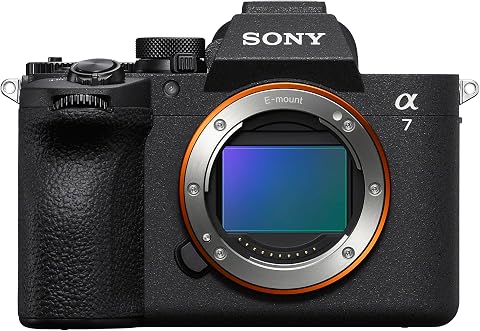 Sony Alpha 7 V Full-Frame Mirrorless Camera Body, 33 MPView on Amazon →
- 2
 Canon EOS R6 Mark II Mirrorless Camera with RF 24-105mm F4-7.1 IS STM Lens KitView on Amazon →
- 3
 Nikon Z50 II with Two Lenses | Compact mirrorless Stills/Video Camera with Ea…View on Amazon →
- 4
 Canon EOS R50 Mirrorless Camera with 18-45mm & 55-210mm Lenses BundleView on Amazon →
- 5
 Canon EOS R50 Mirrorless Camera RF-S18-45mm F4.5-6.3 is STM Lens KitView on Amazon →
- 6
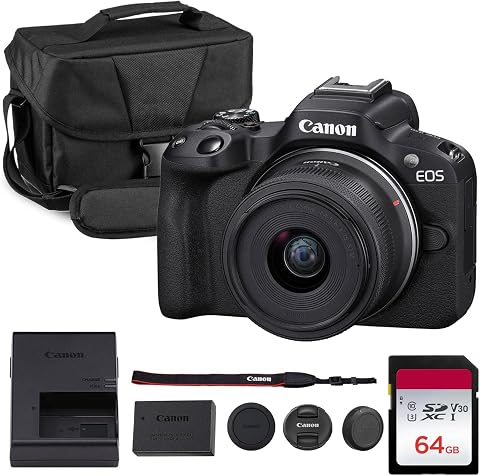 Canon EOS R50 Mirrorless Camera with 18-45mm Lens BundleView on Amazon →
- 7
 Sony Alpha a6400 Mirrorless Camera: Compact APS-C Interchangeable Lens Digita…View on Amazon →
- 8
 Canon EOS R100 Mirrorless Camera with RF-S 18-45mm Lens BundleView on Amazon →
- 9
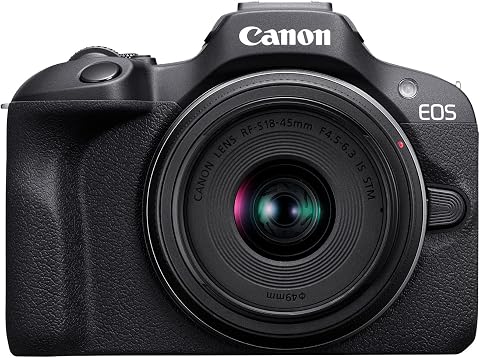 Canon EOS R100 Mirrorless Camera RF-S18-45mm F4.5-6.3 is STM Lens KitView on Amazon →
- 10
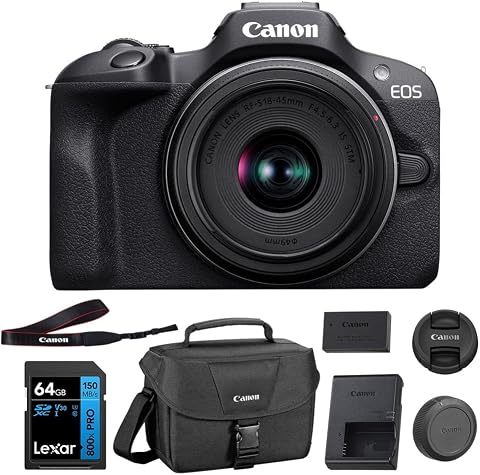 Canon EOS R100 Mirrorless Camera with 18-45mm Lens BundleView on Amazon →
How Sensor Choice Shapes the Cost
The guide frames the main buying decision as a tradeoff between full-frame image advantages and system cost. Full-frame bodies can gather more light and produce shallower depth of field, according to the source, but they may also require larger, more expensive lenses. The total cost of a camera system can therefore exceed the body’s listed price.
APS-C cameras can offer smaller, lighter kits and a narrower field of view that may help when photographing distant subjects. The source presents that compactness as a practical advantage, not proof that APS-C models are better for every user. For shoppers, matching the camera to the subjects they photograph, their budget and the lenses available for its mount may matter more than choosing the highest-resolution body.
The recommendations are best treated as a starting point rather than a verified universal ranking. Without the six omitted models, prices, test conditions and individual results, readers cannot assess how the full list compares across budgets or whether the picks remain good value in their local market.
Popular right now

De'Longhi Magnifica Evo Automatic Espresso Machine with Milk Frother – Silver

Ninja CREAMi 7-in-1 Ice Cream Maker, NC301

De'Longhi Magnifica Evo Fully Automatic Espresso Machine with Manual Milk Frother
As an affiliate, we earn on qualifying purchases.
The Buying Criteria Behind the List
The source says its framework prioritizes real-world use over megapixel counts alone. It argues that dependable subject tracking can be more useful than extra resolution when photographing action, while native lens availability affects whether buyers can expand a system without relying on adapters. It cites Sony’s E-mount and Canon’s RF-S range as having broader immediate choices than some newer or niche mounts; this is the source’s assessment, and the extract provides no lens-count comparison.
For hybrid stills and video users, the guide recommends checking 4K frame rates, color depth, recording limits and screen design. It notes that a fully articulating display and audio-monitoring connections can help vloggers and filmmakers, while crop or recording-time limits may affect practical use. The supplied text stops before completing its discussion of video specifications, so it does not establish which of the named cameras meets particular production needs.
“I evaluated these ten models based on three core pillars: image quality, autofocus reliability, and long-term usability.”
— ThorstenMeyerAI.com, describing the selection method
Six Picks and Test Evidence Missing
The supplied source extract does not name six of the 10 promised cameras, provide the complete ranking, or give model-specific prices. It also contains no detailed test scores, sample-image comparisons, or precise autofocus and video measurements. Readers therefore cannot verify the full budget range or compare all 10 recommendations from this material alone.
The source refers to autofocus trends in 2027, but gives no publication date or evidence supporting its assessment of which brands lead in eye tracking. Camera prices, firmware, lens availability and competing models can change; the extract does not say when the recommendations were checked. It is also unclear whether the list reflects hands-on testing, manufacturer specifications, or a combination.
Check the Full List Before Buying
Readers should consult the complete guide for the six unnamed models, current prices and full comparisons before treating the article as a 10-camera shortlist. A prospective buyer can then compare body and lens costs, verify the camera’s video limits and confirm that the mount offers lenses suited to their needs.
No follow-up date or additional testing is stated in the supplied material. Until the complete ranking and its evidence are available, the confirmed recommendations are limited to the Sony Alpha 7 V, Canon EOS R50, Canon EOS R100 and Nikon Z50 II.
Key Questions
Which camera does the guide recommend for professionals?
It names the Sony Alpha 7 V as its professional pick, describing it as a full-frame option. The supplied extract does not include the complete ranking or supporting test results.
Which model is presented as a beginner choice?
The guide highlights the Canon EOS R50 for creators who prioritize ease of use and connectivity. It also describes the Canon EOS R100 as an entry-level APS-C option.
Does the source identify all 10 cameras?
No. The supplied material names four models: the Sony Alpha 7 V, Canon EOS R50, Canon EOS R100 and Nikon Z50 II. It does not identify the other six.
Should I choose full-frame or APS-C?
The source describes full-frame as offering low-light and depth-of-field advantages, while APS-C can make for a smaller, lighter system. The better fit depends on your budget, subjects, portability needs and the cost and availability of lenses.
Source: ThorstenMeyerAI.com