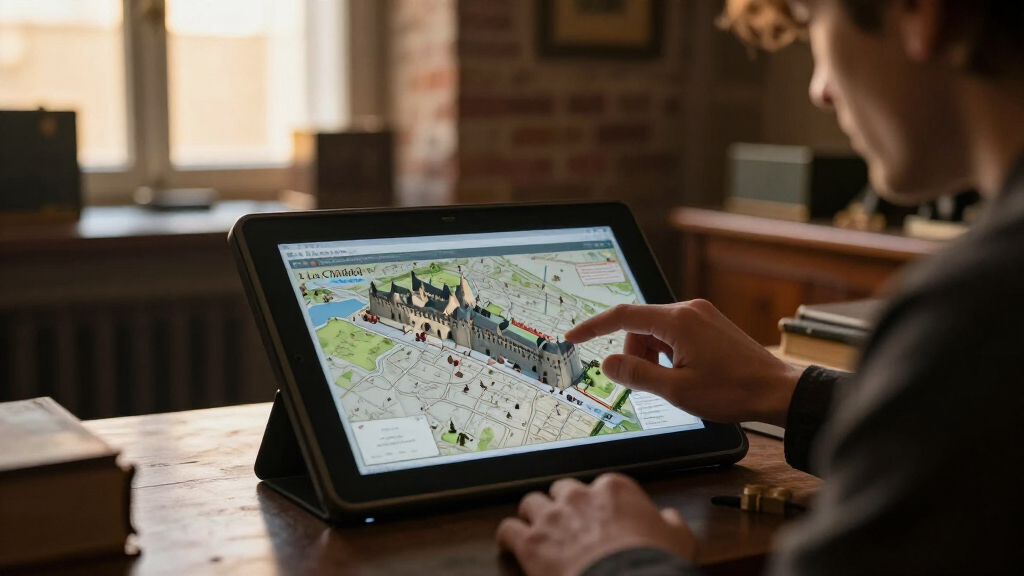

🔍 Read the full analysis: AI-Driven Digital Archives: Reimagining La Citadelle’s 1693 Siege on ThorstenMeyerAI.com

Get business pricing on office and shipping supplies
- Business-only prices and quantity discounts
- Tax-exempt purchasing
- Multiple users, one account, clear invoices
TL;DR
A new AI-powered digital archive vividly reimagines the 1693 siege of La Citadelle. Using layered SVGs, CSS, and canvas, it offers an interactive, cinematic experience. This development highlights AI’s role in preserving and presenting history.
An AI-generated interactive exhibition now offers a detailed reconstruction of the 1693 siege of La Citadelle, utilizing layered SVGs, CSS, and canvas elements to simulate the historic event. Developed through a streamlined AI-guided workflow, this digital monument balances historical accuracy with artistic storytelling, providing viewers with a cinematic, explorable experience. The project exemplifies how AI can transform digital preservation and education, making complex historical events accessible and engaging in a new format. For a detailed exploration of the siege, see La Citadelle — An Anatomy of Siege, 1693.
The exhibit, titled La Citadelle — An Anatomy of Siege, 1693, is hosted on a dedicated online platform where visitors can navigate a scroll-driven, animated diagram of the fortress and surrounding terrain. The site employs a restrained color palette rooted in parchment, fortress ink, and vivid red accents, establishing an archival atmosphere. It features a multi-layered SVG siege map where each layer—grid, fortress, trenches, and trajectories—is animated to depict earthworks, artillery fire, and breach formations in real time. The animations are orchestrated solely through JavaScript, CSS, and SVG, with no static images or external assets used, ensuring high scalability and fidelity across devices.
According to Thorsten Meyer, the project follows a three-stage workflow: initial construction using layered SVGs, iterative critique with AI analysis for visual coherence and historical plausibility, and final approval by an art director. This process is detailed in the original analysis. This process is guided by an AI-generated manual emphasizing layered architecture and emotional depth rooted in the fictional siege narrative. The site also integrates detailed typography—using fonts like Cinzel, EB Garamond, and Space Mono—to create a layered textual hierarchy that complements the visual storytelling. Learn more about the historical context in the original analysis here.
The cinematic ambiance is enhanced through CSS transforms, parallax effects, and animated textures modeled after historical engravings, all without static images. The design aims for flawless rendering at multiple screen widths, with accessibility features such as tap targets of at least 44 pixels and contrast ratios exceeding 4.5:1. The project exemplifies how AI can facilitate complex, layered digital exhibits that are both educational and aesthetically restrained.
Transforming Digital History with AI Technology
This project demonstrates the potential of AI to revolutionize digital history preservation by creating interactive, highly detailed reconstructions of complex events. It offers an immersive experience that enhances understanding of military engineering and siege tactics from the late 17th century, making history accessible to a broader audience. The use of AI-guided critique and automatic content layering ensures high fidelity and responsiveness, setting a new standard for digital exhibits. For educators, historians, and technologists, this approach signals a shift toward more dynamic, engaging, and accurate digital representations of the past, fostering deeper engagement and learning.
interactive digital archive software
As an affiliate, we earn on qualifying purchases.
As an affiliate, we earn on qualifying purchases.
Historical and Technological Foundations of the Siege Reconstruction
The 1693 siege of La Citadelle, a fortress in Montfaucon, was a pivotal event in military history, exemplifying Vauban-style fortification and siege tactics. Prior efforts to digitally preserve such events relied heavily on static images or simplified animations, limiting engagement and detail. This project builds on recent advances in AI, web graphics, and interactive design, leveraging layered SVGs and CSS to create a cinematic, explorable map of the siege. The development process involved a manual critique cycle, guided by AI analysis of visual coherence and historical plausibility, to refine the digital reconstruction. This approach aligns with broader trends in digital humanities, where AI enables more nuanced and layered storytelling of historical events.
“This project exemplifies how AI can elevate digital history by combining meticulous detail with engaging storytelling, making complex events accessible and immersive.”
— Thorsten Meyer
As an affiliate, we earn on qualifying purchases.
Limitations and Areas for Further Development
While the exhibit offers a highly detailed and cinematic reconstruction, it remains a digital simulation based on historical interpretations and AI-generated content. The accuracy of specific military movements and terrain details depends on available historical data and AI critique, which may have limitations. Additionally, the project’s reliance on AI-guided critique and manual approval introduces subjective elements that could influence the final presentation. It is also not yet clear how the exhibit will evolve with user feedback or if similar approaches will be adopted for other historical events on a broader scale.
As an affiliate, we earn on qualifying purchases.
Future Enhancements and Broader Applications of AI-Generated Exhibits
Developers plan to incorporate user interaction data to refine animations and improve historical accuracy. There is also interest in expanding this AI-driven approach to other historical sieges and battles, creating a library of digital reconstructions. Further integration with educational platforms could enhance learning experiences, while ongoing AI improvements may allow for even more detailed and responsive visualizations. The project’s success could inspire new standards for digital preservation, blending AI critique, layered graphics, and cinematic storytelling to reimagine history for digital audiences.
As an affiliate, we earn on qualifying purchases.
Key Questions
How accurate is the digital reconstruction of the 1693 siege?
The reconstruction is based on available historical data and AI analysis, aiming for high fidelity. However, it remains a simulation, and some details are interpretative or speculative, depending on the sources and AI critique.
Can users interact with the exhibit beyond scrolling?
Yes, the site features interactive elements such as hover effects and clickable layers that animate or reveal additional information, enhancing engagement and educational value.
What technologies power this digital exhibit?
The project uses layered SVGs, CSS transforms, JavaScript for animations, and HTML5 Canvas for trajectories and textures, all built without external frameworks or static images, ensuring scalability and fidelity.
Will this approach be used for other historical events?
Developers are exploring expanding this AI-guided, layered graphic approach to other battles and sieges, aiming to create a comprehensive digital history library.
Source: ThorstenMeyerAI.com
Fall Picks
fall essentials
As an affiliate, we earn on qualifying purchases.