
📊 Full opportunity report: Outcome-First Decisions: Keep, Change, or Kill on ThorstenMeyerAI.com — validation score, market gap, and execution plan.
TL;DR
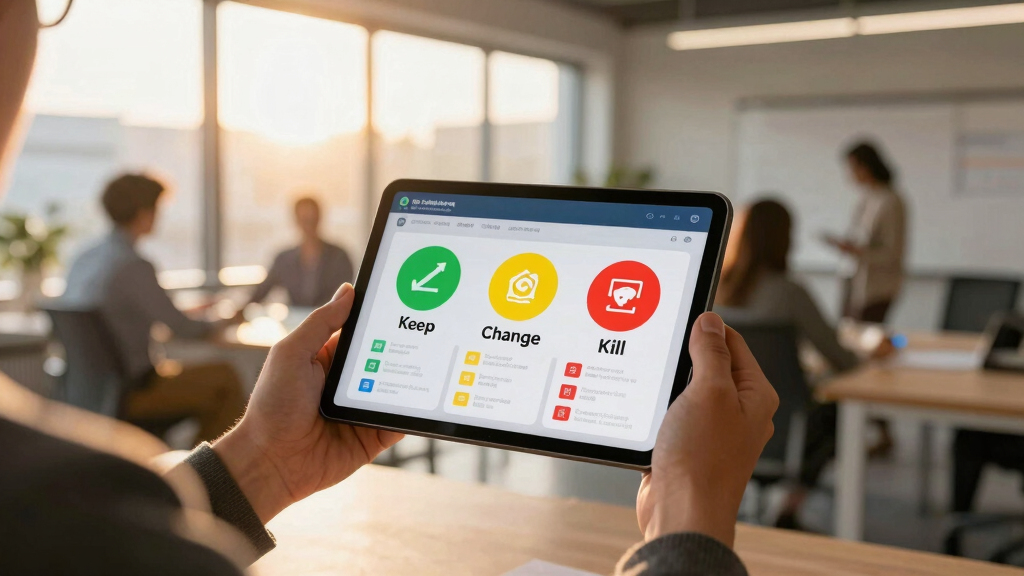
Outcome-First Decisions offers a framework for evaluating ongoing initiatives by their current outcomes, enabling organizations to decide whether to keep, change, or kill projects. It emphasizes pruning to improve efficiency and capacity.
A new decision framework called Outcome-First is being promoted as a way for organizations to evaluate whether ongoing projects or initiatives should continue, be modified, or be terminated, based solely on their current outcomes. This approach aims to address the common problem of organizations maintaining dead or underperforming initiatives due to sunk costs, emotional attachment, or organizational inertia.
Outcome-First is built around a simple yet powerful question: given where a project or initiative currently stands, is the outcome it produces worth its ongoing cost? This contrasts with traditional evaluation methods that often focus on past investments or effort. The framework introduces the Worth Filter, which encourages decision-makers to judge forward-looking outcomes rather than backward-looking effort or sunk costs.
Developed as an open-source tool under the AGPL-3.0 license, Outcome-First is designed to be provider-agnostic and runs on local compute, allowing frequent and honest reviews without external dependencies. It aims to serve as the final decision node in a portfolio management cycle, closing the loop by routinely assessing whether initiatives should continue, be modified, or be terminated.
While the framework promotes making kill decisions easier, it acknowledges potential risks, such as mismeasured outcomes, premature killing of slow-start projects, or emotional resistance. It emphasizes that the tool can remove analytical excuses but cannot eliminate emotional or organizational barriers to ending initiatives.
Outcome-First Decisions — keep, change, or kill
The hardest decision isn’t what to start — it’s what to stop. Judge every initiative by the outcome it produces now, not the effort already spent.
Independent commentary, produced with AI assistance under human editorial oversight. The views are the author’s own and may change. Outcome-First Decisions is open source under AGPL-3.0, provided “as is” without warranty; see the repository LICENSE. The framework’s verdicts are reasoning aids based on the inputs given and may be wrong — decision support, not decisions; verify independently before acting. Product and company names are trademarks of their respective owners; mention does not imply endorsement.
Why Outcome-First Decisions Reshape Portfolio Management
This framework offers organizations a disciplined method to prune underperforming projects, freeing capacity and resources for more valuable initiatives. By focusing on current outcomes rather than past effort, it encourages more rational and efficient decision-making, potentially reducing waste and improving overall organizational agility. However, its success depends on accurate outcome measurement and organizational willingness to accept tough decisions, including ending initiatives that are still valued emotionally or culturally.
Testing BI and ETL Applications with manual and automation approach: A comprehensive guide for Business Intelligence project evaluation
As an affiliate, we earn on qualifying purchases.
As an affiliate, we earn on qualifying purchases.
The Challenge of Maintaining Dead Projects in Organizations
Many organizations accumulate a long tail of ongoing projects and commitments that no longer produce meaningful results but continue due to sunk costs, identity, or effort justification. These ‘zombie’ initiatives drain resources, distract focus, and hinder strategic agility. Traditional evaluation methods often fail to address this issue effectively, leading to organizational bloat. Outcome-First aims to provide a practical, repeatable process to identify and eliminate such initiatives based on current performance rather than past investments.“The hardest decision in any portfolio isn’t what to start, but what to stop. Outcome-First helps make that decision clearer.”
— Thorsten Meyer, source developer of Outcome-First

The New Dynamic of Portfolio Management: Innovative Methods and Tools for Rapid Results
As an affiliate, we earn on qualifying purchases.
As an affiliate, we earn on qualifying purchases.
Unresolved Challenges in Applying Outcome-First
It remains unclear how organizations will accurately measure and interpret outcomes, especially for slow-start or long-term projects. There is also uncertainty about how organizations will handle emotional resistance or cultural barriers to ending initiatives, even when the framework suggests termination. The effectiveness of Outcome-First in diverse organizational contexts and its integration into existing decision processes are still being evaluated.

Marzano Resources Untangling Data-Based Decision Making: A Problem-Solving Model to Enhance MTSS (A practical tool to help you make sense of student data for effective use in MTSS)
As an affiliate, we earn on qualifying purchases.
As an affiliate, we earn on qualifying purchases.
Next Steps for Adoption and Validation
Organizations interested in Outcome-First are expected to pilot the framework within their portfolios, adapting metrics and processes to fit their context. Further validation studies and case reports are anticipated to assess its impact on resource efficiency and decision quality. Continued development and community feedback will shape refinements to the framework and its practical deployment.

October Is Yours
As an affiliate, we earn on qualifying purchases.
As an affiliate, we earn on qualifying purchases.
Key Questions
How does Outcome-First differ from traditional project evaluation?
It focuses solely on current outcomes and ongoing worth, rather than past investments or effort, enabling more rational decisions about continuation or termination.
Can Outcome-First prevent organizations from prematurely killing slow-start projects?
The framework emphasizes outcome measurement, but it cannot fully account for slow-start projects that may need more time to prove value. Judgment and context remain important.
Is Outcome-First suitable for all types of organizations?
Its effectiveness depends on the ability to measure outcomes accurately and organizational willingness to act on those evaluations. It may require adaptation for different sectors or cultures.
Is the framework open for customization?
Yes, it is open source under the AGPL-3.0 license, allowing organizations to adapt metrics and processes to their specific needs.
Source: ThorstenMeyerAI.com