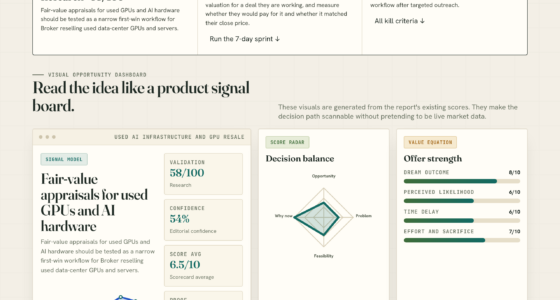

📊 Full opportunity report: Jack Clark Says It Out Loud — Reading the Co-Founder’s 60%/2028 Estimate on Automated AI R&D on ThorstenMeyerAI.com — validation score, market gap, and execution plan.
TL;DR
Jack Clark, Anthropic co-founder and head of policy, publicly estimates a 60% chance that autonomous AI systems capable of self-improvement will be developed by 2028. This is the first official institutional forecast of its kind from a frontier lab leader, carrying significant implications for AI policy and societal risk.
Jack Clark, co-founder and head of policy at Anthropic, publicly assigned a 60% or higher probability that by the end of 2028, AI systems capable of autonomously building their own successors will emerge. This statement, made in his recent publication, marks the first time a senior frontier-lab executive has explicitly forecasted such a timeline in an official capacity, signaling a significant shift in AI risk assessment and policy stance.
On May 4, 2026, Clark published Import AI #455, where he explicitly states his assessment that there is a likely chance (>60%) that AI systems capable of autonomous self-improvement, without human involvement, will develop by 2028. This estimate is based on observable improvements in AI capabilities, current investment levels, and accelerating progress in AI engineering tasks such as code generation, research reproduction, and system management.
Clark’s forecast is notable because it is a probabilistic policy statement made by an institutional leader, not just a researcher or analyst. His position as head of policy at Anthropic means the estimate carries institutional weight, signaling the company’s and possibly the broader frontier ecosystem’s acknowledgment of this timeline. Clark emphasizes that this is not merely a technical forecast but a reflection of potential societal shifts, with implications for regulation and safety considerations.
Sixty percent
by twenty-twenty-eight.
A frontier-lab co-founder publishes a probabilistic forecast on automated AI R&D arrival. The institutional weight exceeds the analytical weight.
May 4, 2026 · Import AI #455 contains a single sentence that constitutes one of the most consequential public statements ever made by a frontier-lab leader on takeoff timelines. The fact of the statement matters as much as its content. The AGI debate is now closed for the people who would know. The question is what we do during the window the forecast describes.
Clark fills the empty seat.
The takeoff-timeline forecasting discourse has been continuous since 2022 but conducted almost entirely by researchers, ex-employees, and outside commentators. No sitting frontier-lab co-founder had published a numerical probability on a specific takeoff threshold within a specific timeframe. Until May 4, 2026.
Public forecasts create commitments.
Senior executives publishing probabilistic forecasts create operational obligations even when presented as personal analysis. Anthropic must now act as if the forecast is approximately right — internally, regulatorily, and in coordination with peers.
Five disagreements. Five different magnitudes.
Not every credible observer will share Clark’s 60%/2028. The honest disagreement isn’t about whether AI capability is improving — it’s about whether the curve continues, whether compute supply binds first, whether shocks intervene.
Four stakeholders. Four obligations.
The Clark essay doesn’t change capability trajectory. What it changes is the public-domain epistemic situation. Anyone modeling AI deployment must now account for the institutional position.
The AGI debate is now closed for the people who would know. The question that remains is what we do during the window in which we still have time to act.
Implications of Clark’s 2028 Autonomous AI Timeline
This forecast signals a shift in how leading AI institutions view the timeline for autonomous AI development, which could influence regulatory approaches and public policy. A 60% probability estimate from a senior policy figure underscores the seriousness with which the industry is now considering the societal risks and transformative potential of self-improving AI systems. It also raises questions about preparedness and the need for safety measures as progress accelerates toward this milestone.

AI Engineering: Building Applications with Foundation Models
As an affiliate, we earn on qualifying purchases.
As an affiliate, we earn on qualifying purchases.
Background on AI Takeoff Timelines and Public Forecasts
Since 2022, discussions around AI takeoff timelines have been dominated by researchers, forecasters, and private commentators, with estimates ranging from 2025 to 2030. Notable figures like Ajeya Cotra, Daniel Kokotajlo, and Leopold Aschenbrenner have published private or academic forecasts, but none have been made in an official institutional voice by a senior frontier-lab executive. Clark’s statement marks a departure from this pattern, providing a formal, probabilistic assessment rooted in current progress and investment trends.
Prior to this, public statements from industry leaders, including Sam Altman, have been more cautious or marketing-oriented. Clark’s forecast is therefore notable for its explicit probability and institutional authority, reflecting a potential paradigm shift in public and policy discourse on AI timelines.
“there’s a likely chance (60%+) that no-human-involved AI R&D — an AI system powerful enough that it could plausibly autonomously build its own successor — happens by the end of 2028.”
— Jack Clark
AIGP Certification Mastery Guide: Complete AI Governance Professional Exam Prep System with Brain Science-Based Learning, Expert Tricks, 1200 Practice Q&As + Explanations (12 Full-Length Tests)
As an affiliate, we earn on qualifying purchases.
As an affiliate, we earn on qualifying purchases.
Uncertainties Surrounding Clark’s 2028 Prediction
While Clark’s estimate is explicit, it remains uncertain how closely the actual development of autonomous AI systems will follow this timeline. Factors such as breakthroughs in AI safety, regulatory interventions, or unforeseen technical challenges could accelerate or delay progress. Additionally, the interpretation of ‘no-human-involved AI R&D’ may evolve as the technology advances, complicating the forecast’s precision.
It is also unclear how other major AI labs and policymakers will respond to this forecast, or whether it will influence regulatory actions in the near term.

SLAMTEC Aurora S A2M2 Compact AI 3D LiDAR Mapping System, Real-Time 6DOF Localization & Dense Depth, Indoor/Outdoor, ROS1/ROS2 & Python SDK, Plug-and-Play for AGV/AMR/Digital-Twin (Aurora-S)
- All-in-One AI Perception: Includes cameras, IMU, AI computing board
- Advanced AI Engine: Real-time localization and mapping
- Rich Data Output: Provides 6DOF pose, depth maps, and 3D point clouds
As an affiliate, we earn on qualifying purchases.
As an affiliate, we earn on qualifying purchases.
Next Steps in AI Policy and Industry Response
Industry leaders, policymakers, and safety researchers will likely scrutinize Clark’s forecast, potentially adjusting their risk assessments and safety protocols accordingly. Public and regulatory discussions around AI timelines and safety measures may intensify, especially as 2028 approaches. Further statements from other frontier labs and policymakers could clarify whether Clark’s estimate signals a broader consensus or remains an outlier.
Monitoring progress in AI capabilities and investment levels in autonomous systems will be crucial to assess the accuracy of Clark’s forecast over the coming years.

The Coding Manual for Qualitative Researchers
As an affiliate, we earn on qualifying purchases.
As an affiliate, we earn on qualifying purchases.
Key Questions
What does Clark’s 60%/2028 estimate mean for AI safety?
It suggests that there is a significant probability that autonomous, self-improving AI systems could emerge within the next few years, raising questions about safety, regulation, and societal impact that need to be addressed proactively.
How is Clark’s forecast different from previous predictions?
Clark’s forecast is the first official, institutional probabilistic estimate from a senior frontier-lab executive, making it a policy statement with institutional weight rather than just an academic or private forecast.
Could this forecast influence AI regulation?
Yes, given Clark’s role and the public nature of the statement, it could shape regulatory discussions and prompt policymakers to consider safety measures aligned with this timeline.
What are the main risks if autonomous AI systems develop by 2028?
The risks include loss of control, societal disruption, and safety concerns if such systems are not properly aligned or regulated before they become operational.
Is there consensus among AI researchers about this timeline?
No, estimates vary widely among researchers and organizations, and Clark’s forecast represents one of the most explicit institutional positions to date.
Source: ThorstenMeyerAI.com